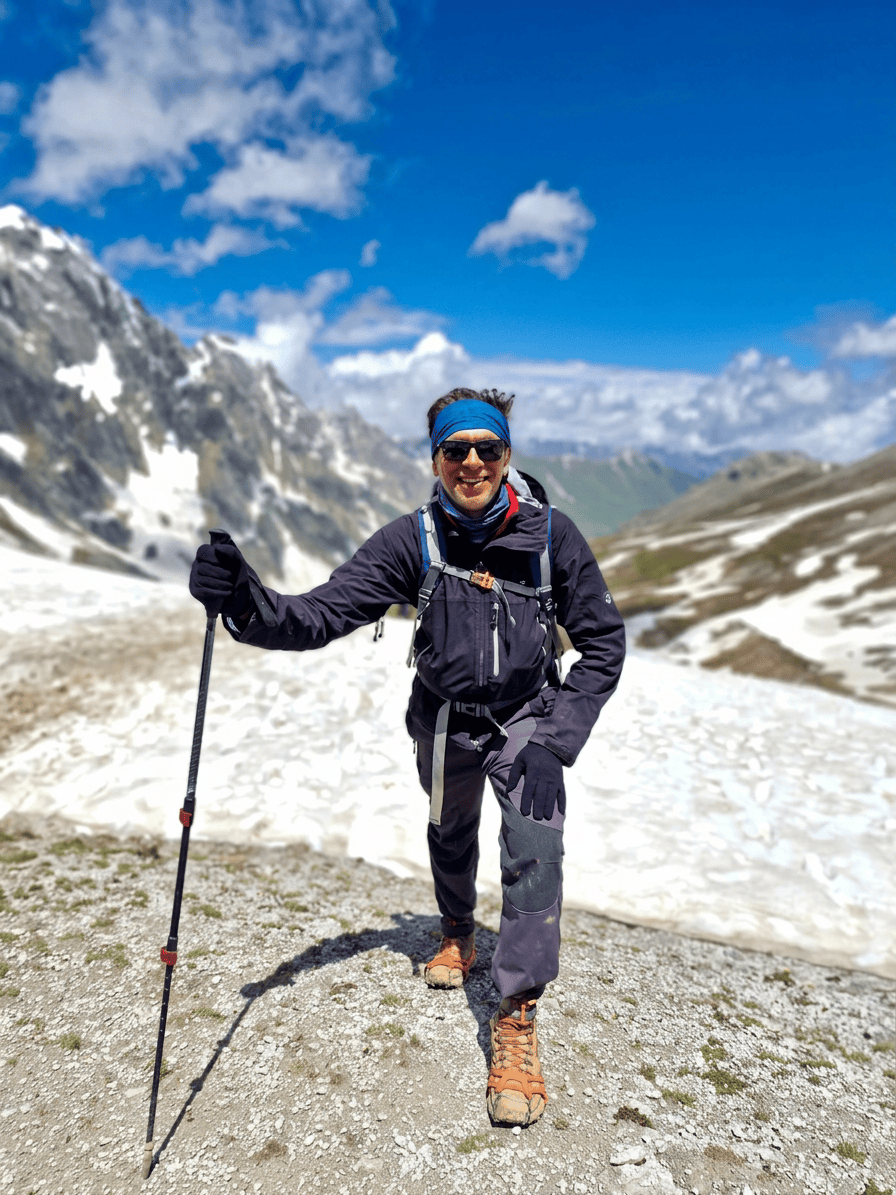
Why We Trek
Himalayan treks sort themselves, roughly, into a few broad categories. There are the summit attempts — physically demanding, technically challenging, the kind where the objective is a point on a map at altitude and everything else is in service of reaching it. There are the cultural treks — routes through villages, monasteries, and market towns where the landscape is the frame and the people are the story. There are the spiritual and religious treks where the journey is itself the devotion and the destination carries a weight that has nothing to do with altitude. And there are the remote and alien landscape treks where the appeal is the strangeness, the feeling of being somewhere that does not resemble anywhere else on Earth.
But the treks that stay with you longest are the routes where the reward is not a single viewpoint earned once. Where the beauty is not the destination but the entire journey. These routes are rarer. When you find one, you remember it differently from all the others.
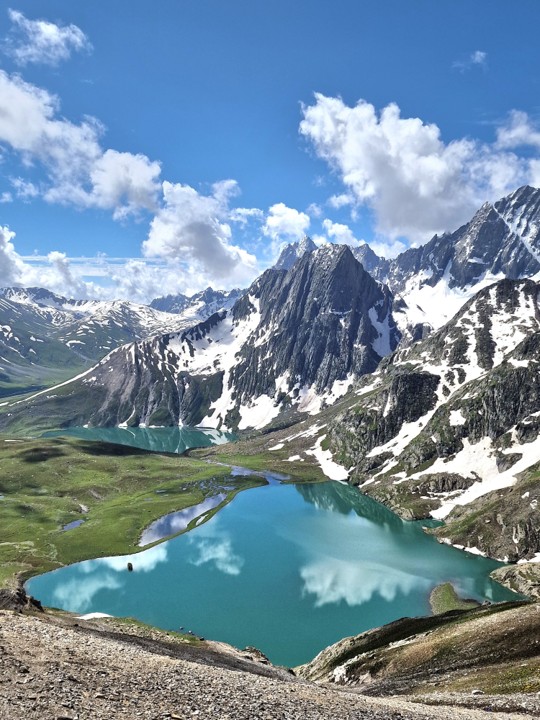
The Kashmir Great Lakes trek is one of those routes. Seven days. Seven lakes. Five high-altitude passes.
There is nothing repetitive about it. Every morning begins in a different place and ends somewhere new, and the thing waiting on the other side of each pass is always, without exception, worth the climb to get there.
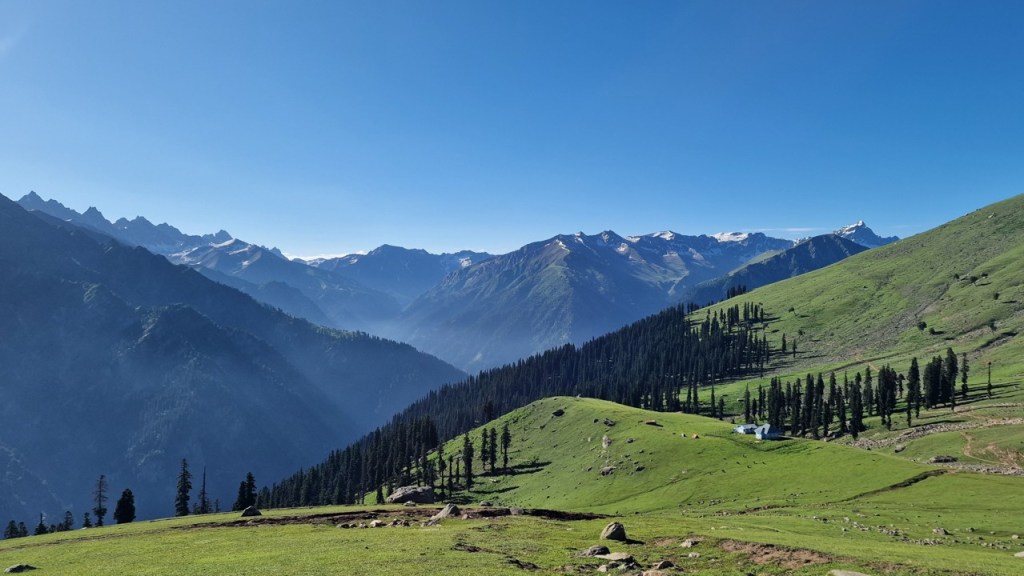
It begins at Sonamarg in the Kashmir valley — the Meadow of Gold.
The Paperwork Before Paradise
The Kashmir Great Lakes trek begins with documentation. Army checkpoints, forest department registrations, identity verification at multiple points along the route — ID cards checked more than once a day, groups turned back if paperwork is incomplete.
But the checkpoint forces you to ponder. The Kashmir Great Lakes is not formally restricted because it sits on the Line of Control — the permits here are forest protection and regulated tourism management as much as border security. What they produce, however, is a landscape that remains genuinely intact. The number of trekkers permitted each season is a fraction of what a route of this quality would attract if it were as freely accessible as Pahalgam, which carries the visible weight of its own popularity in peak season. The Great Lakes, for now, do not.
The army post at the start of the trail is the unlikely reason the lakes beyond it are still worth the walk.
Seven Days, Five Passes, Seven Lakes
The Kashmir Great Lakes route connects seven lakes across five passes over seven days. It begins with a climb that is steeper than expected. Then steeper still. Then a section that appears to be the top but isn’t — the Himalayas are generous with false summits and offer them without apology. And then the actual pass arrives, and below it is a lake, and the calculation of whether you had enough left in reserve no longer applies.
Five times. The same arc. You know it is coming and it works anyway.
The route begins modestly enough — a forest path from Sonamarg that gives no particular indication of what is coming. Then the first climb toward Nichnai Pass, and the first introduction to Kashmiri mud. The kind that is deep, cold, and gets inside your boots within the first ten minutes and stays there as a companion for the rest of the day. By the time the path levels toward the Nichnai valley the lower half of most trekkers has been mud-packed from the knee down, clothes and poles and bags sharing a uniform coating that will become, over the following days, simply the normal state of things. The first valley camp is lush, the stream cold and clear, and the evening light on the surrounding ridges makes the mud feel like a reasonable price.
Day two brings the first proper test. The climb toward Vishansar demands everything the legs have, and then asks for a little more. Somewhere in the upper section the path crosses a stream via what appears to be a tree trunk placed horizontally across the water. More like an intention of a bridge, a single log balanced over a torrent. The technique for crossing it involves committing fully to each step, not looking down at the water, and ignoring the subtle flex of the trunk under your weight. On the far side, breathing rather more than the exertion strictly required, the path continues upward.
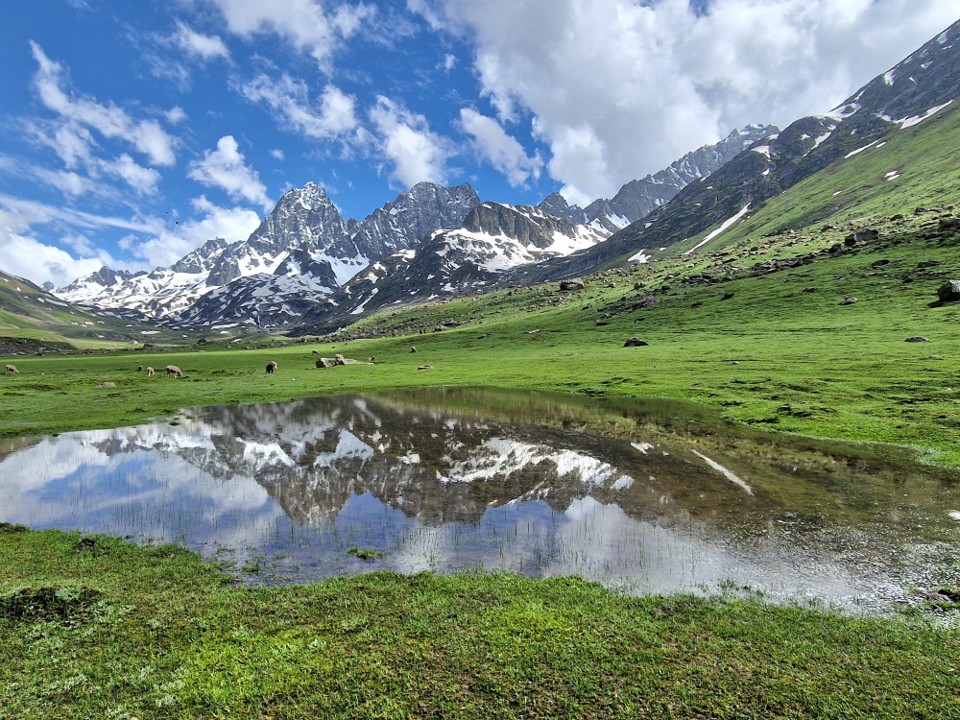
Vishansar arrives without warning. You come over a final rise and it is simply there — deep blue, cold, ringed by meadows carrying wildflowers in improbable variety and density. After two days of forest and mud and a questionable log bridge, the effect is startling. This, you think, is what we came for. You are right, and you do not yet know how right, because there are more lakes ahead.
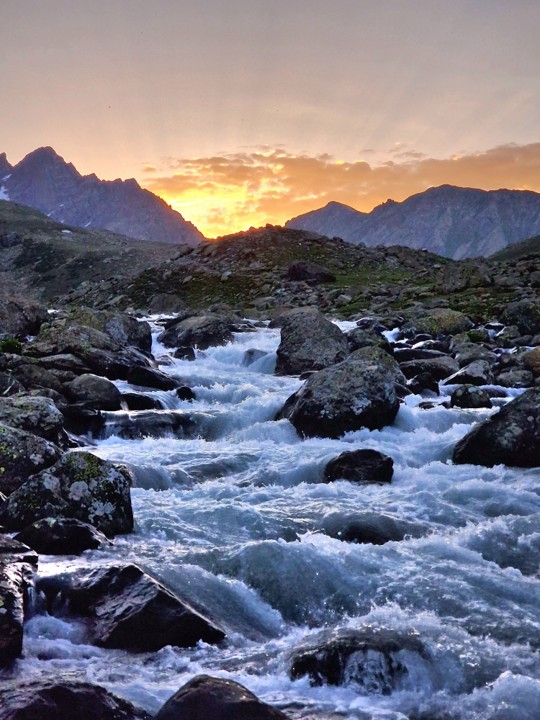
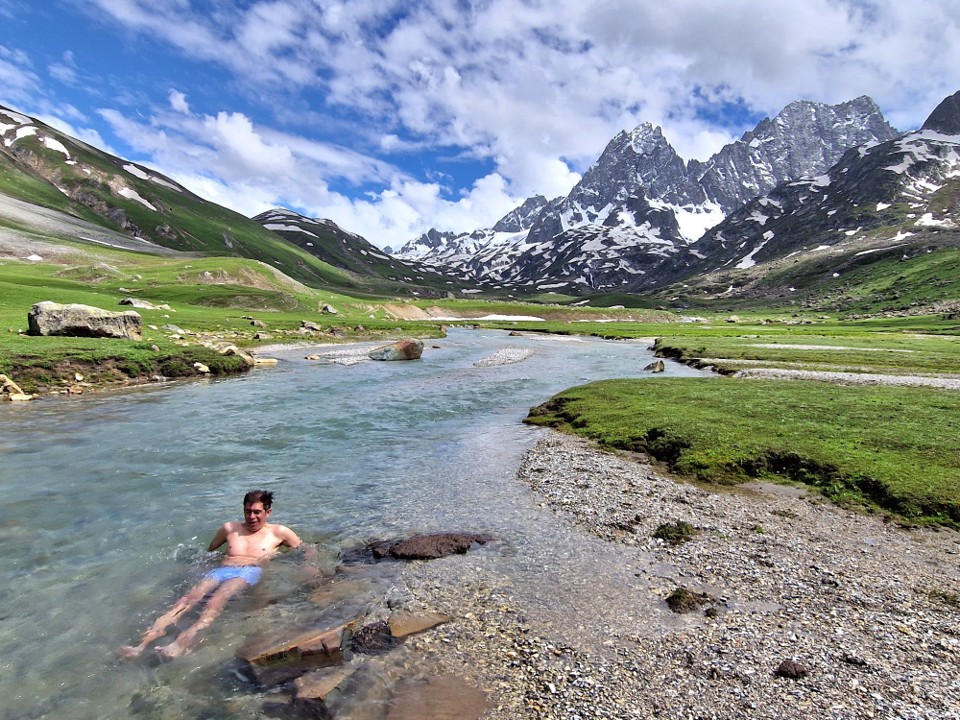
Kishansar sits just beyond and slightly higher than Vishansar, connected by a thin channel, its water a shade greener, the surrounding terrain more open. Krishnasar comes next, after a crossing that involves wading a glacial stream whose temperature is best not measured and best not lingered in. Boots off, poles planted, water at mid-shin — the cold arrives at the feet and works its way up. On the far bank, the rocks are slippery, the current insistent. You emerge onto dry ground and ahead is Krishnasar Lake.
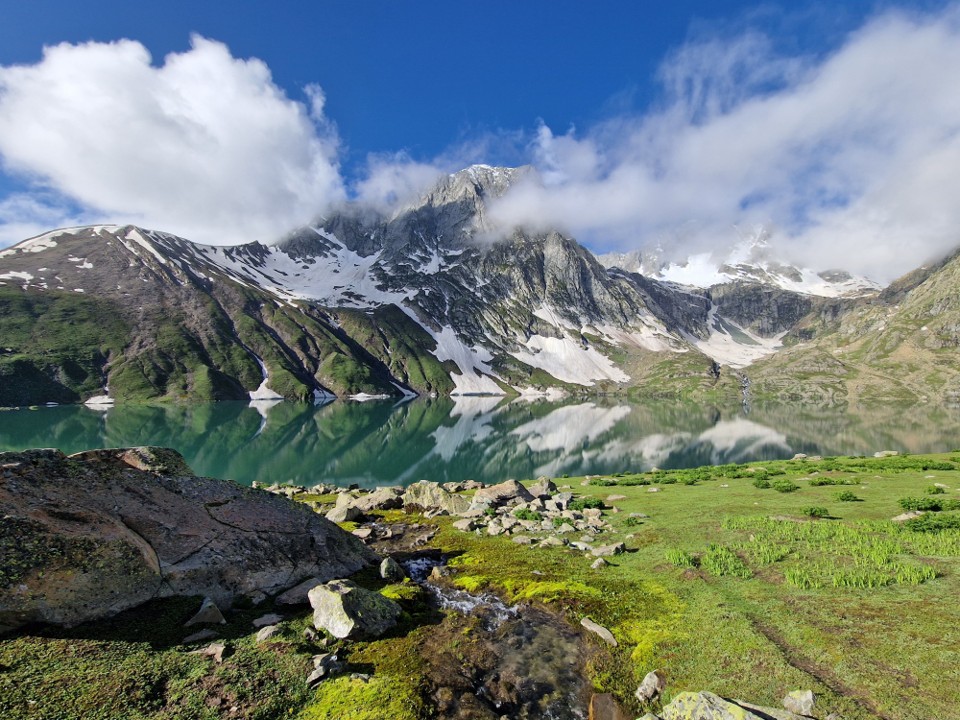
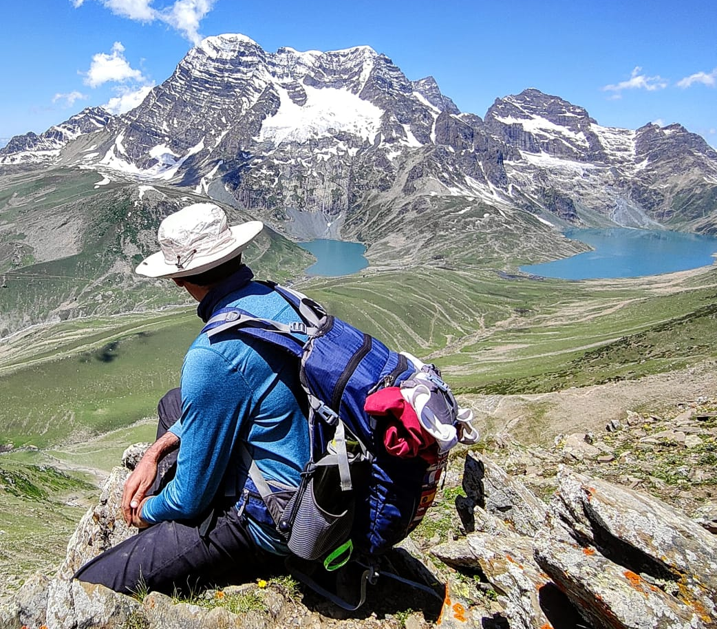
Many consider Krishnasar the finest of the seven. It sits in a bowl ringed by high ridgelines, its surface on a clear day reflecting the surrounding peaks with such precision that the image above and the image below become equally persuasive. You sit at the edge and eat whatever food you have left and the lake holds the mountains and the mountains hold the sky and just get lost in the beauty of it all.
The approach to Gadsar Pass — the fourth and hardest — is where the route makes its intentions clear. The climb begins as a steep zigzag, becomes a boulder field where the path is more theoretical than actual, and then becomes a snow gully. In early season the snow is deep and the gully is steep and the technique involves kicking steps in the crust, which would hold for two steps and collapse for the third, depositing you six inches lower than your intended position. Progress is made in the way that difficult things are made — slowly, and then a little more slowly, and then from somewhere the top arrives.
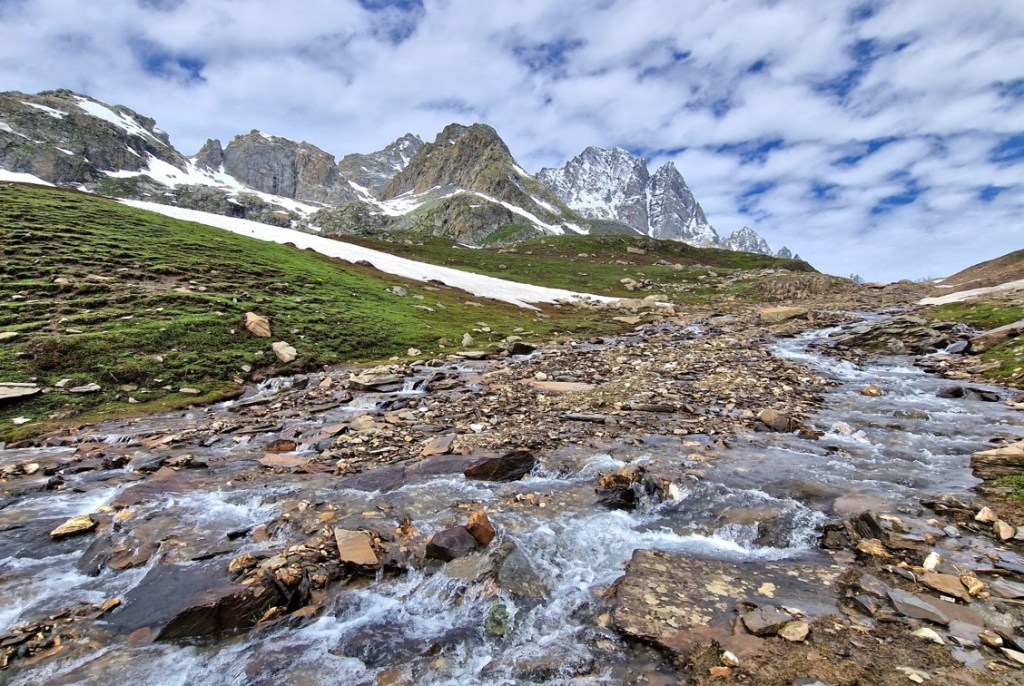
It was somewhere in the boulder field below the Gadsar Pass, scrambling on all fours across a section where the path had entirely given up, that I heard the whistle. Then another. Then a third, and suddenly the boulder field was alive — fat, rust-red animals sitting bolt upright on every available flat surface, regarding me with the alarm of sentries who have spotted something suspicious. Himalayan marmots: built like overfed house cats, possessed of an alarm call of entirely disproportionate drama. The call is deployed for snow leopards, golden eagles, and apparently also for trekkers scrambling on all fours, whom they appear to rank in the same threat category. A moment of stillness. Then, at some signal I did not catch, every marmot in the boulder field vanished underground simultaneously. Ten seconds earlier, a dozen animals. Now: empty boulders, and the wind.
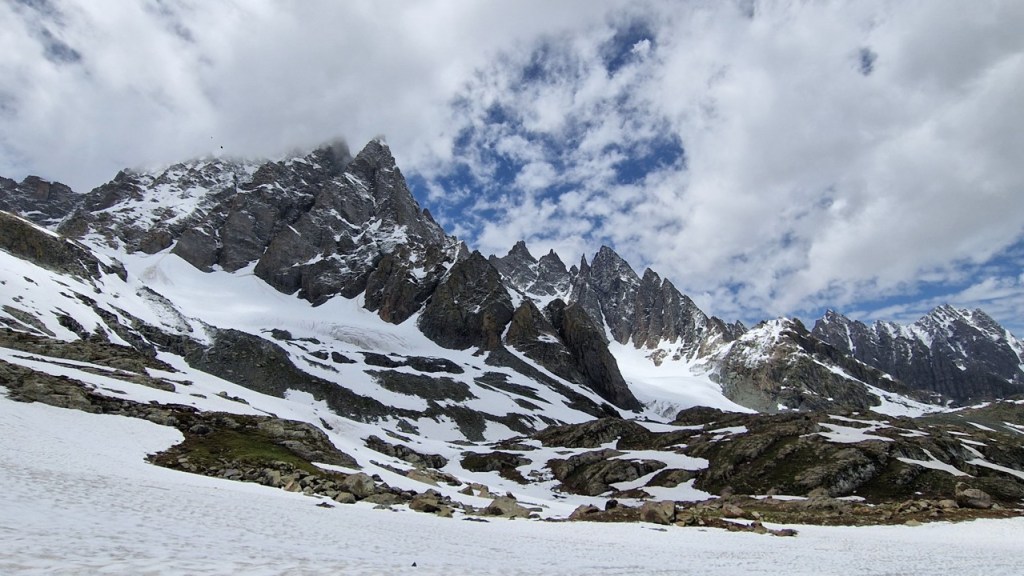
From the top of Gadsar Pass, on a clear day, the horizon to the northwest holds something that stops you where you stand. Nanga Parbat — 8,126 metres, the Killer Mountain, the westernmost of the world’s fourteen eight-thousanders — rises alone above the surrounding landscape with the authority of something that has earned its reputation. Its fatality rate in the early decades of Himalayan mountaineering was the worst of any 8,000-metre peak. From a boulder field at Gadsar, with mud-caked clothes and a marmot still reconsidering its opinion of your trekking poles somewhere underground, Nanga Parbat looks both impossibly large and entirely real.
Gadsar Lake lies below the pass on the far side — wilder and more remote than its predecessors, the one that feels furthest from anything recognisable as ordinary life. The Satsar is a cluster of smaller lakes in a meadow that surprises you with its generosity — you come over a rise expecting one lake and find several, each one a slightly different shade of blue-green depending on depth and the angle of the light.
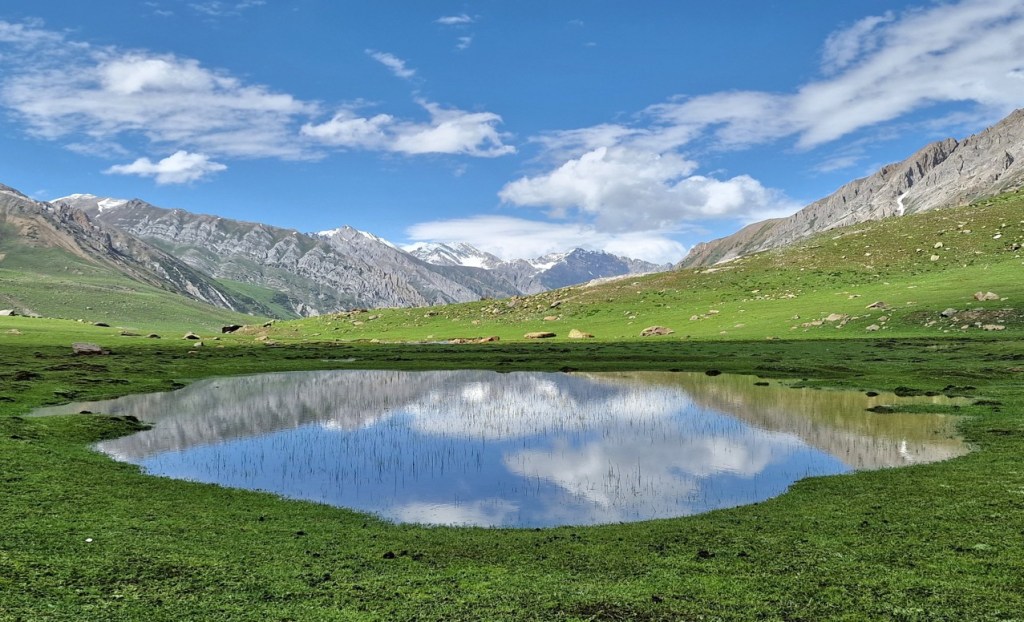
The final ascent toward Gangabal — the largest of the seven, with Harmukh peak reflected in its surface — involves a snow gully that in early season requires an ice axe and in later season requires the particular patience of someone who has learned that slipping is going to happen and falling well is a skill worth developing. The valley below Gangabal opens like a reward that was calibrated precisely to what the climb demanded. The lake at five in the evening, with Harmukh’s reflection holding steady on a surface ruffled only at the edges, is the kind of sight that makes the sequencing of the whole journey feel designed. Six lakes have been building toward this. The seventh is the answer.
Between all of this: shepherds. The Bakarwal and Gujjar families who spend five months in these valleys arrive after the snow clears and leave before it returns, the same movement for generations. Their settlements are simple — shelters of wood and canvas, large protective dogs that communicate their feelings about approaching strangers without ambiguity, woodsmoke carrying across the evening meadow. The purpose of the summer is the flock: thousands of sheep and goats fattening on the rich alpine grass that makes these valleys so beautiful, heading to market in time for Eid al-Adha. The same meadows a trekker walks through for the wildflowers are, to the shepherd, a feeding ground with a commercial calendar. Both things are true simultaneously.
The passes that consume a trekker’s entire reserve in a day are, to the Bakarwal, a commute. The shepherd will overtake you on the ascent, goats cascading ahead in every direction, and be at the top before you have cleared the false summit.
Earn This One
The Kashmir Great Lakes is not a trek to do early. This is not a warning about difficulty — although it is difficult — but about readiness. There is a version of this route where you are too tired to receive what it is offering, where the pass consumes everything and the lake at the bottom is something you register rather than feel. That version is not the one worth having. The version worth having requires legs that know what a pass is, lungs that have been at altitude before, and a mind that has learned — from earlier, harder, less rewarding treks — how to stay present when the body is protesting.
There is also a sequencing argument in the other direction. Do the Kashmir Great Lakes too early in your trekking life and you create a problem for every route that follows. The standard of comparison becomes very difficult to meet. Other lakes will be beautiful. They will not be Krishnasar. Other meadows will be green. They will not carry this particular green. Do the intermediate routes that build the legs and the lungs and the patience. And then, when you are ready — when you have earned the capacity to receive it properly — come here.
The trek will ask something of you on every pass. It will take your breath, your footing, your confidence, and occasionally your dignity, in that order. And then it will give you a lake.
Every time, without exception, the lake is worth it.
(where the army kept the gates, the Bakarwal kept the stories, the marmots kept the noise — between them, they kept the magic)
— Kashmir Great Lakes, Jammu & Kashmir


Leave a Reply