Calgary: The Subcontinent Arrives First
The journey to Banff began in Calgary, which is where most journeys to Banff begin, and where — I was about to discover — the Indian diaspora has been quietly and comprehensively solving the breakfast problem.
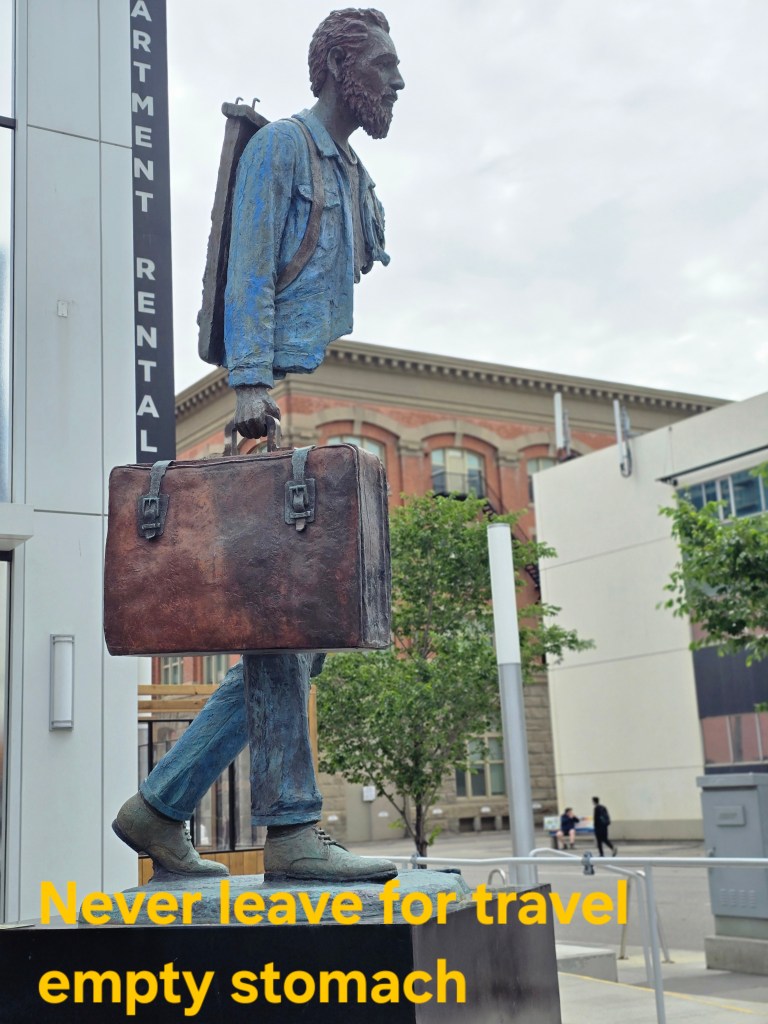
I had expected the usual McDonalds, Diner café or Applebees options on the road. What I found instead, within a short drive of where we were staying, was the kind of choice that would not embarrass Delhi or even Amritsar. Parantha palace, Chicken Khurana, Madras café, chaiwala boards all in the same complex with food cooked with the specific confidence of someone who learned the recipe from their mother and has made no concessions to geography. Breakfast was Paranthas that arrived at the table the correct temperature, with the correct amount of butter, and the correct weight in the hand. A chai that tasted of cardamom and ginger served with Parle G was as good as anywhere in dilli. We delayed our departure to Banff by a margin and reconciled with the myth that a journey begins properly only when the traveller is properly fed.
Canmore: The Town That Reinvented Itself
Canmore town sits at the gateway to Banff National Park, and was, for most of its history, a coal mining town — the kind of settlement whose economy depends on extracting something from the ground until there is nothing left to extract, and then faces the particular challenge of figuring out what comes next.
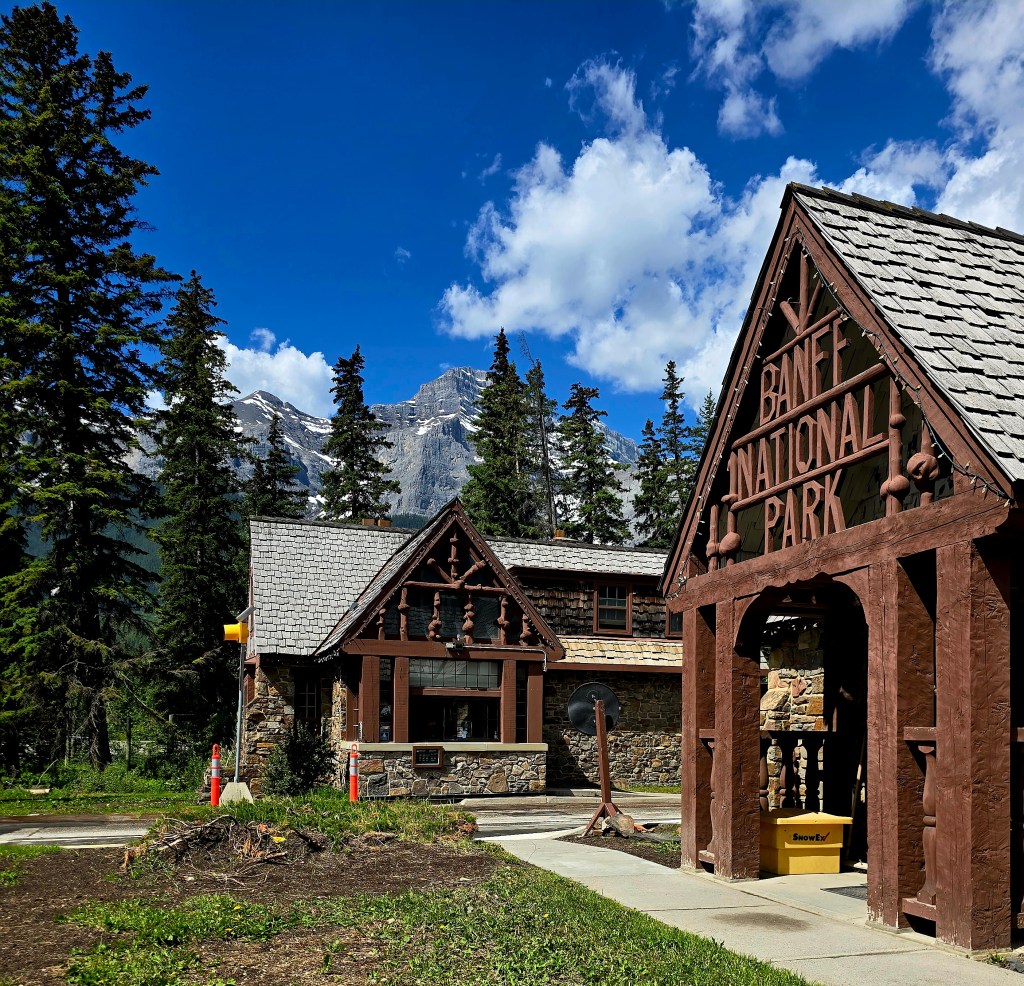
What Canmore chose to be next is, by any measure, an impressive piece of reinvention. The town has oriented itself entirely around the landscape that surrounds it, and the result is a place that feels purposeful rather than merely pretty. The Bow River Trail and legacy trail — multiple dedicated path for cyclists, walkers, and joggers, with motorised vehicles entirely excluded — runs along the river and around the viewpoint for the Three Sisters, the trio of peaks that dominate the skyline above the town with a symmetry that seems almost deliberate.
We had rented bicycles for this section of the journey. Side-by-side tandem electric bicycles, to be precise, which I will acknowledge immediately is not the most rugged mode of mountain transport. The electric assist meant that our cruising speed of around ten kilometres per hour felt entirely effortless and I was aware that passing serious cyclists — lean, lycra-clad, unassisted — regarded us with that didain on steep paths.
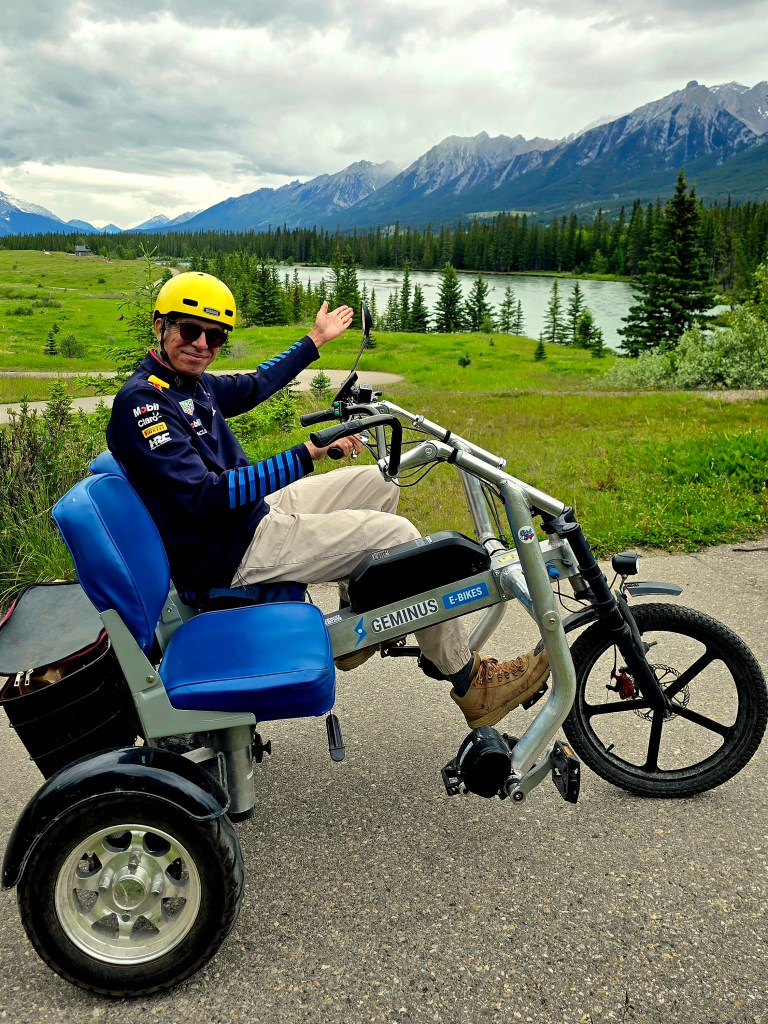
I was wearing an F1 racing jersey. This combination — the jersey, the fluorescent helmet, me slouching in the tandem electric bicycle, the ten-kilometre-per-hour cruise speed, pedalling serenely along a river trail through some of the most spectacular mountain scenery in Canada brought a smile to many people that morning. The Three Sisters didnt care for that and looked magnificent throughout.
Johnston Canyon: Bear Spray and Bear Bells
Before the Icefields Parkway, there was Johnston Canyon — a trail that follows a glacial creek through a limestone gorge, past waterfalls and hanging catwalks bolted into the canyon wall, through a forest that is beautiful and also, the information boards make pleasantly clear, very much occupied by wildlife.
The Canadian Rockies take bears seriously. Not in conservation-poster sense, but in the practical, what-do-you-do-if-you-meet-one sense. The advice is thorough: make noise on the trail so you don’t surprise them, carry bear spray and know how to use it, do not run. Bear spray, for the uninitiated, is a pressurised canister of capsaicin concentrate with a range of about eight metres, designed to be discharged at a charging bear as a deterrent. It is sold in outdoor shops alongside water bottles and energy bars, as a critical survival gear in the same category. We were strongly encouraged to carry it. We did.
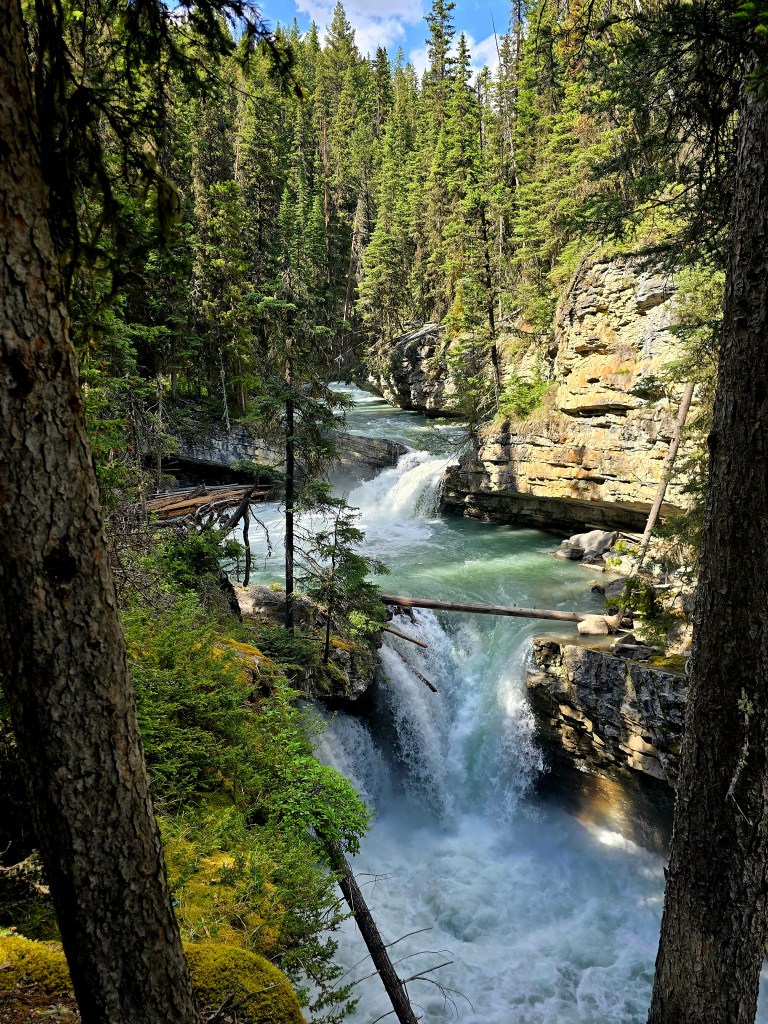
The other standard precaution on busy wildlife trails is the bear bell — a small brass bell attached to a pack, bag, or in some cases a person, that jingles with every step and announces your presence to any bear within earshot. The effect is charming in the way that wind chimes are charming, and on Johnston Canyon, where the trail was well-frequented on a clear summer day, the combined sound of several dozen hikers with bear bells attached produced a gentle, continuous tinkling that echoed off the canyon walls and accompanied the waterfall and the birdsong. It sounded, frankly, festive.
The bells rang all the way to the upper falls and back, and the canyon was spectacular, and I remain uncertain whether I would actually have the presence of mind to deploy eight metres of capsaicin concentrate at short notice.
The Icefields Parkway: 250 Kilometres of Silence
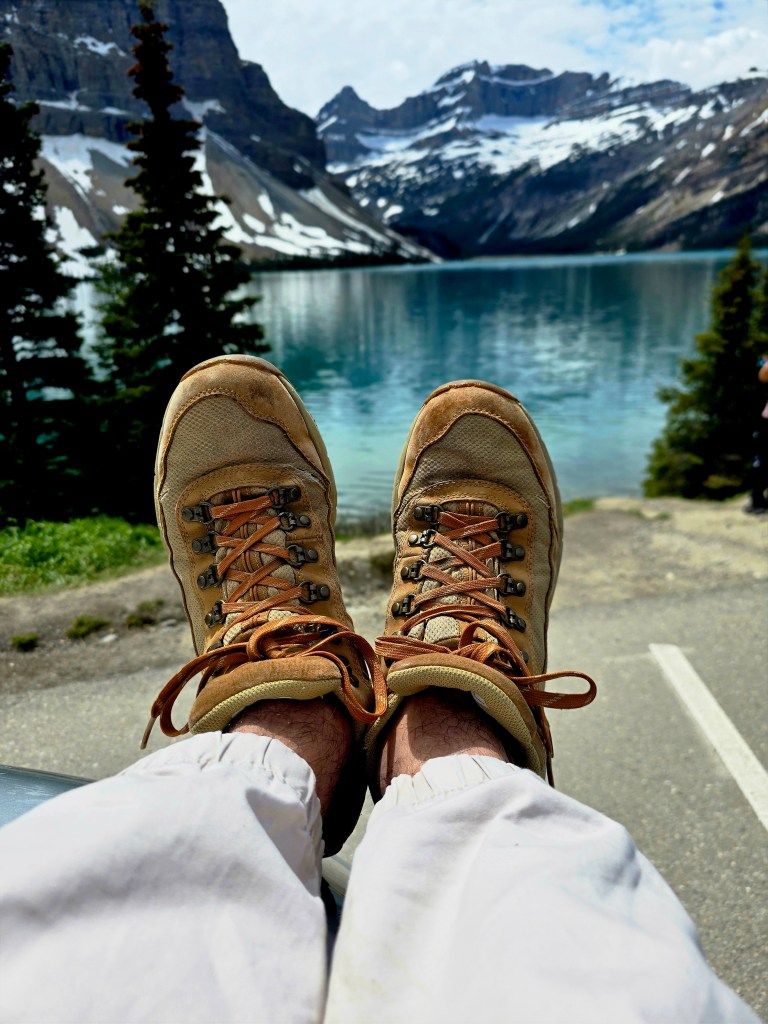
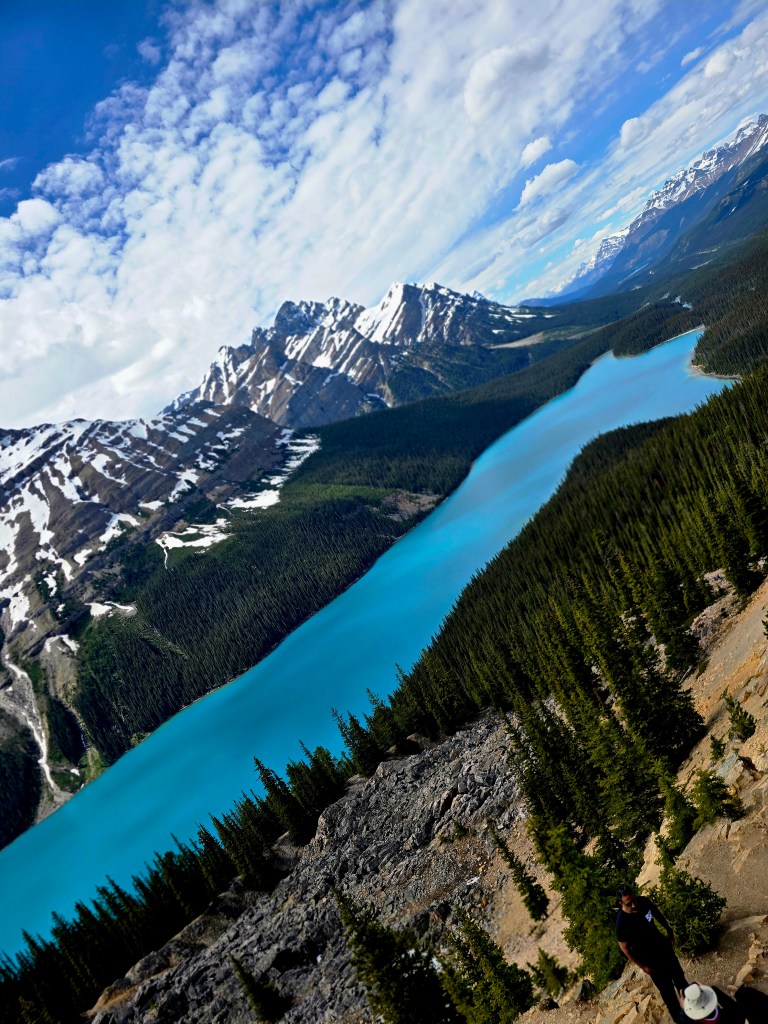
The drive from Banff to the Columbia Icefield along Highway 93 — the Icefields Parkway — is easily my most scenic outstanding natural beauty drive ever. Castle Mountain stands like something that decided to be a fortress rather than merely a peak. Bow Lake sits in its glacial bowl with the flat, improbable turquoise that glacial lakes achieve and that no photograph quite reproduces faithfully. Peyto Lake — a short hike from the highway through subalpine forest — is the colour of a swimming pool in a dream, that particular blue-green that looks artificial until you are standing above it and understand that the glacier above is releasing rock flour into the water and the water is doing the rest.
Somewhere around the hour mark on the Parkway, mobile signal disappeared. Not faded — disappeared, the particular blankness of a phone that has nothing to report and has stopped trying.
The initial reaction was a faint anxiety. The checking of the phone. The recalculation of how far we were from the next town and whether anything had been said in the last known period of connectivity that required a response.
And then, after perhaps twenty minutes, something else. A settling. The mountains, which had been visible through the windscreen all along, became more present. The decisions about where to stop, what to photograph, which viewpoint to take, were made by looking rather than consulting. Conversation in the car became the primary entertainment.
It turned out to be the best stretch of the journey. What we tell ourselves about connectivity — that it keeps us informed, that it helps us navigate, that it is a tool we control — does often disconnect us from ourselves and our surroundings.
The Glacier That Is Leaving
The Columbia Icefield Adventure involves boarding what the operators call an Ice Explorer — a vehicle with wheels roughly the height of a small person, designed to travel across the Athabasca Glacier on terrain that would stop anything else. The Skywalk — a glass-floored viewing arch that extends over a cliff edge — offers a view of the valley below through the floor under your feet.
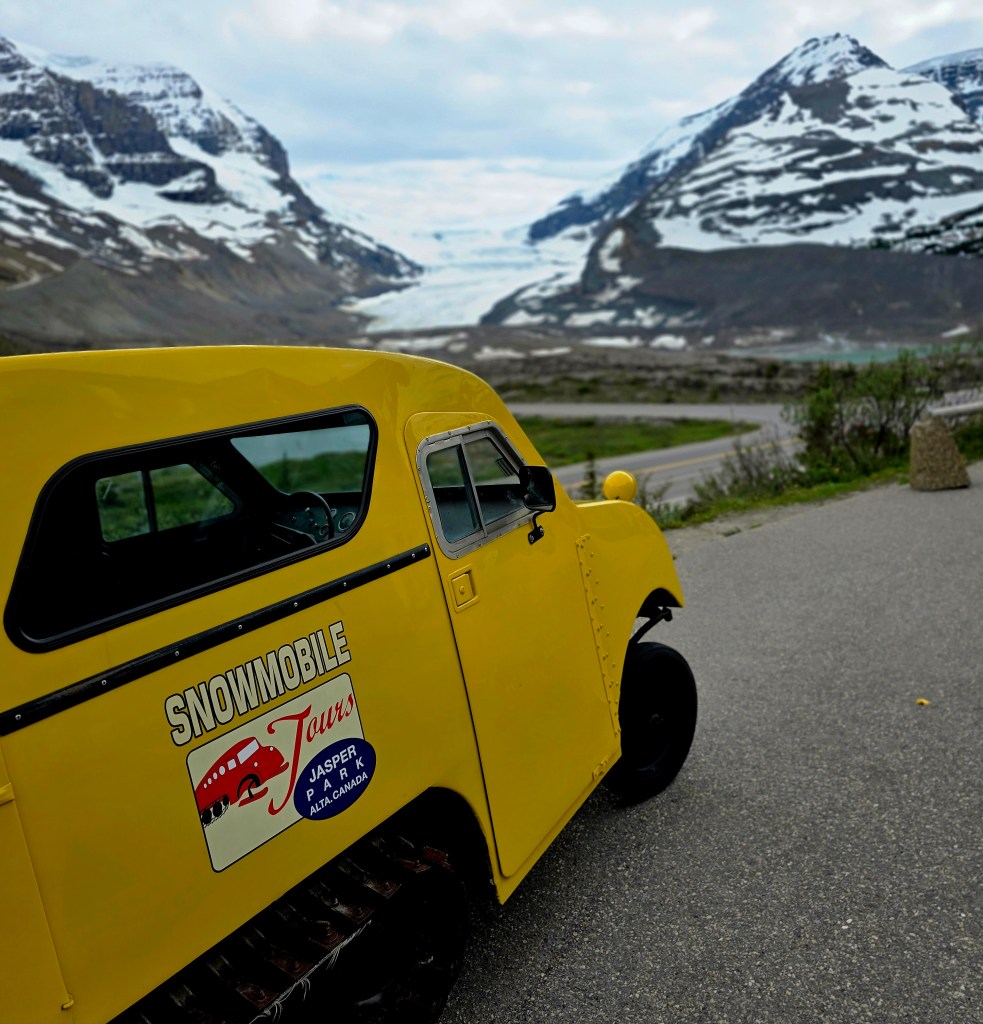
The glacier itself is the reason to be here and the reason to pay attention. Markers along the approach road show where the ice edge stood in previous decades — 1980, 1990, 2000, 2010, each one further from the current terminus than the last. The retreat is not gradual in the way that comfortable language about climate change often implies. It is substantial, visible, and documented in a series of signposts that make the timeline impossible to look away from. The Athabasca Glacier has lost more than half its volume since measurements began. The rate of loss is accelerating.
Standing on the ice, you feel the particular weight of something that has been here for ten thousand years and is not going to be here for another ten thousand. The Ice Explorer, the Skywalk, the visitor infrastructure — all of it exists because the glacier is worth visiting, and all of it contributes, in small ways, to the conditions that are shrinking what you have come to see. This is not a comfortable thought to have on a glacier, but it is the right one.
Lake Louise, and the Art of Saying No to Cars
Lake Louise in summer is one of those places where the beauty and the crowd have reached a kind of standoff. The lake itself — that famous, almost confrontational turquoise against the Victoria Glacier — is as spectacular as advertised, one of those views that lives up to the photograph. The problem, until recently, was that the same accessibility that allowed everyone to see it was also steadily degrading it: traffic, parking, the accumulated impact of several million annual visitors arriving in private vehicles and doing what several million visitors do.
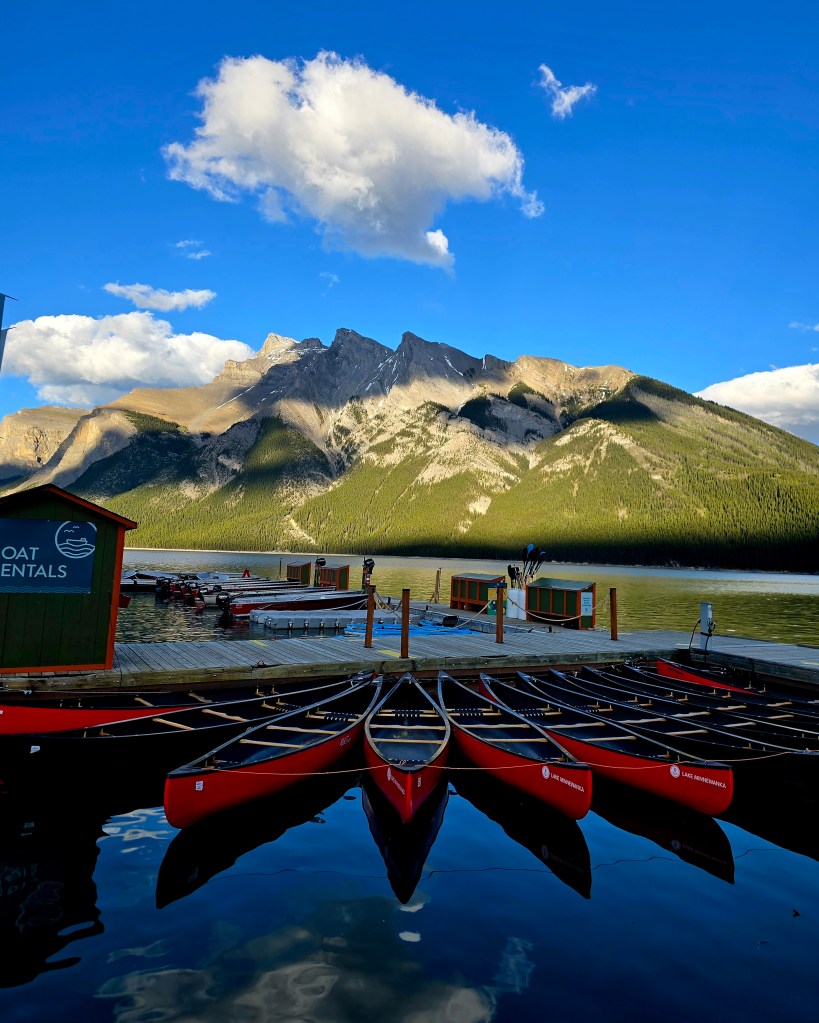
The solution that Parks Canada has implemented is one that more beautiful and pressured places should study carefully. Private car access to the lake is restricted at peak times. Parking is limited to a number that the site can absorb. Shuttle buses — frequent, well-managed, genuinely useful — handle the volume that private cars used to handle badly. Lake Moraine, nearby and perhaps even more spectacular, has taken this further: private vehicles are effectively stopped, and the access is by shuttle or by cycle or foot.
The effect is not, as one might expect, a reduction in the experience. It is an improvement. The lakeside path has space. The reflections in the early morning are not interrupted by a car park. Arriving by shuttle rather than by car means arriving without the decision fatigue of parking. You step off and the lake is simply there.
Its amazing how the latitude delivers as a bonus, is the evening light. In the Canadian Rockies in June, the sun sets somewhere around ten o’clock. By eight in the evening the mountains are still fully illuminated. By nine the light has turned gold. By nine-thirty, on still days, the lakes achieve a mirror quality that photographs register but don’t quite capture — the reflection of the peaks on the water so precise and undisturbed that you are briefly unsure which way is up, the mountain above indistinguishable from the mountain below. Lake Louise at this hour, with the Victoria Glacier holding the last light and the water holding it again underneath, is among the most quietly extravagant things I have seen. It requires no effort. It simply happens, for anyone willing to still be there when the car park crowd has gone home.
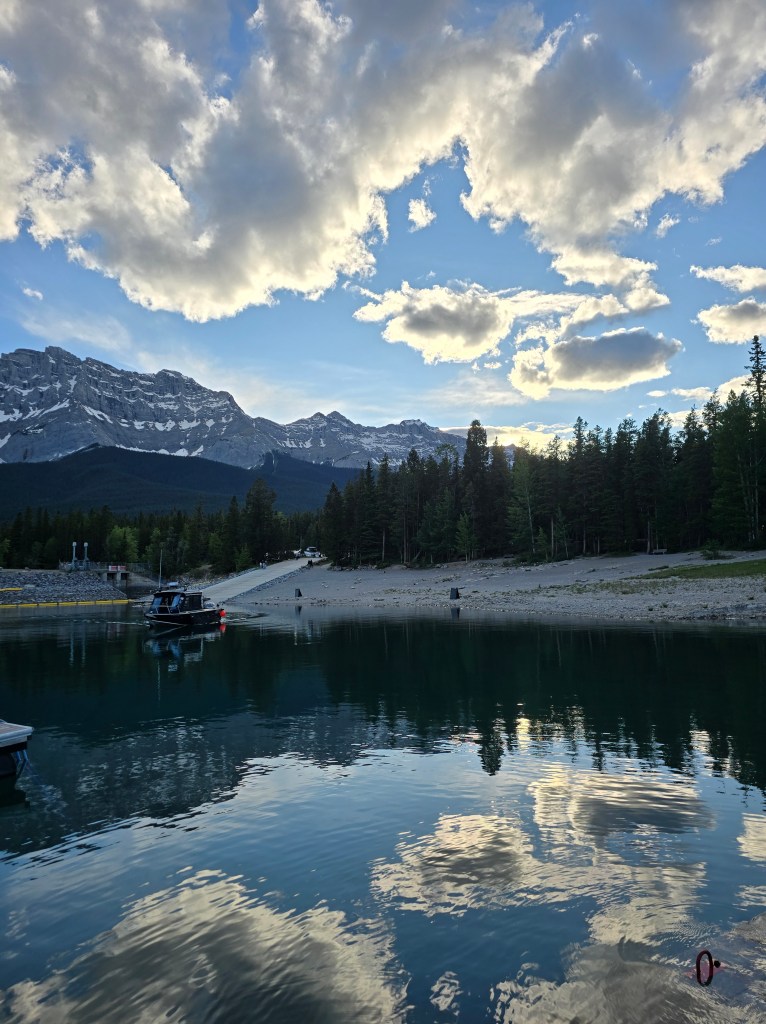
This is increasingly how it will need to work, at the places that everyone wants to see. Not exclusion but management. The recognition that access and preservation are not opposites but partners, and that the way you arrive at a beautiful place is part of the experience of it.
The Same Mountain, Differently
I have spent a considerable amount of time in the Himalayas over the years, and the Rockies raise a comparison that is hard to avoid. The scale is different — the Himalayas are higher, more severe, more demanding. But the feeling is the same. Standing in front of Castle Mountain, or at the edge of a glacier that has been forming since before recorded history, or watching the Victoria Glacier hold its reflection in a still lake at nine-thirty in the evening — you are reminded, that the mountains are vast. We are not. The few places on Earth that still carry this quality are worth extraordinary care. The shuttle buses at Lake Louise, the restricted parking at Moraine, the retreat markers at the Athabasca Glacier documenting what we are already losing: all of it points in the same direction, that the least we can do is arrive at them with the respect that size deserves and leave them as close to intact as we found them.
The aloo parantha and elaichi chai in Calgary were excellent. Good food, it turns out, needs no permit to cross a border. If Banff has lessons to send to the Himalayas about looking after what matters, Calgary can keep the Punjabi breakfast. That seems like a trade worth making.
— Banff National Park, Alberta (with apologies to serious cyclists everywhere for the F1 jersey)


Leave a Reply