The View from the Orchard
My wife Sanju is from Himachal Pradesh, which means that my relationship with the western Himalayas has always been personal in a way that most travel isn’t.
It was on one of those summer visits, staying with Sanju’s family in Theog — an apple village in east Himachal — that I first heard about Shrikhand Mahadev. We had driven up to Sarahan for the day, to visit the Mahakali temple, a beautiful complex of tiered pagoda roofs and carved wooden facades that sits above the Sutlej valley. It was a clear morning. Someone pointed out across the valley to a distant peak and said, simply, that Lord Shiva once lived there.
In Himachal, God Shiva is everywhere. The peaks are named for him or for the stories that surround him. The rivers carry names from the same mythology. For the communities who have lived in these valleys for generations, the mountains are inhabited — by presence, by story, by a devotional geography that most outsiders walk through without quite reading.
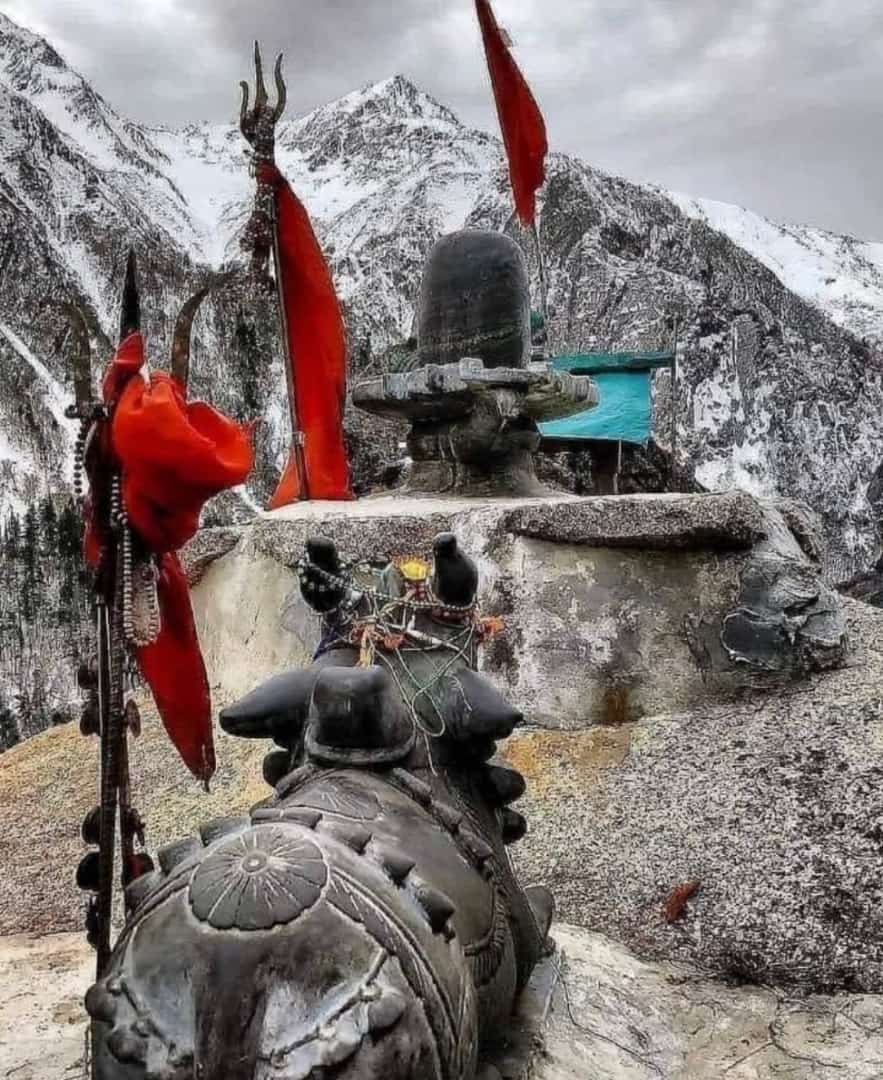
The peak — Shrikhand Mahadev — sits at 5,300 metres. On its summit stands a natural monolith of rock, nearly fifty metres high, balanced with an improbability, as though it was placed rather than formed. One face of the rock, if you look at it at the right angle and with the right quality of attention, appears to carry the features of a face — the matted hairlocks, the straight nose, the firm line of lips. Crude, but at that altitude, imagination and reality have a way of negotiating with each other.
This is the Shivaling. And reaching it, I was told, is an ordeal.
The summit is accessible for only two weeks each year, when the winter snow has melted enough to make the high trails passable. It is one of twelve such peaks in the region dedicated to Shiva — completing all twelve earns a pilgrim the title of Kailashi. The trek requires a medical certificate. It is organised by a local cultural committee. It is steep, slippery, and subject to weather that can change from clear skies to blizzard within hours. Ponies cannot manage the terrain. Porters cannot carry you. The only way up is on your own feet. Standing in the temple courtyard in Sarahan, looking across at that distant rock, I knew I was going to attempt it. The only question was when.
The God Who Became a Dancer
Before the mountain, there is the story. And in the Himalayas, the story always comes first.
Mahishasura was a demon of unusual persistence. After years of severe penance on a high mountain, Shiva granted him a boon — whoever Mahishasura touched would die. Intoxicated by this power, Mahishasura began working through the world and at some stage turned his attention to Shiva himself — reasoning that if he could touch Shiva, he would become the most powerful being in all creation.
Shiva, the master strategist, turned himself into a fly and disappeared into a crack in a mountain. Mahishasura raged outside.
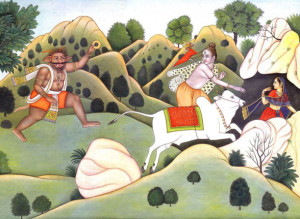
The gods, still suffering, appealed to Shiva to resolve the situation. So Shiva transformed again — this time into Mohini, a dancer of extraordinary beauty and skill. Mahishasura, being overconfidence as he was, was immediately enchanted. He watched the dancer. He was captivated. And then, cleverly, Mohini wove into the dance a sequence in which the hand rose and touched the head.
Mahishasura, mirroring the movements in his delight, did the same.
He touched his own head. And died. And the world was saved.
The Shivaling at the summit of Shrikhand Mahadev marks, in the telling of the local tradition, the place where Shiva emerged at the behest of fellow gods by cracking the rock open and hence sri khand – ‘holy split or crack’. The mountain itself is the site of the story. This is why the pilgrimage matters as its not simply climbing to a viewpoint but tracing the geography of a myth, walking into a story.
The First Attempt — and What the Mountain Said
My first attempt was with a group of work colleagues – Ravi and Sumeet. We arrived at the trailhead in reasonable spirits, at the right time of year, with the right equipment, and the wrong weather.
Persistent rain had made the terrain genuinely treacherous. We reached base camp eventually, which felt like an achievement until we understood what had happened higher up. A blizzard on the high range near the summit had caused fatalities. The local committee — the people who organise and manage the pilgrimage each season — had stopped all new ascents from base camp. Nobody was being allowed to proceed.
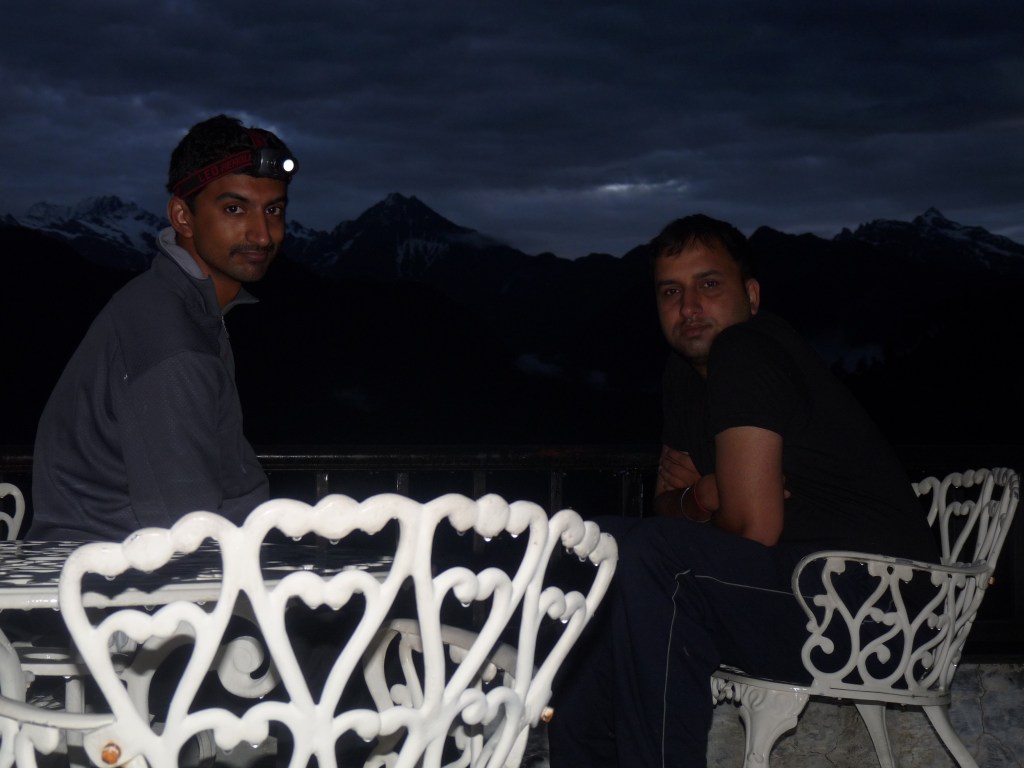
We waited, watching the clouds, hoping. And while we waited, we reflected on the kind of journey it was. This was not an adventure trek. It was a pilgrimage. Along the road to the trailhead, passing vehicles stopped to offer us lifts — free, without being asked. The pharmacist in the nearest town, when we went in for altitude medication, would not take money. At base camp, and at intervals along the route, local families and village committees had set up bhandaras — travelling kitchens, sponsored by community contribution, staffed by volunteers, serving hot food to every pilgrim who passed. Not selling. Serving. Because feeding a pilgrim on the way to Shiva is itself an act of worship. The whole valley, for those two weeks, becomes a kind of extended hospitality — a community organised around the idea that those making the journey are doing something on behalf of everyone.
The weather did not improve. The committee did not reopen the route. With a heaviness that I still remember clearly, we turned back. The mountain had given its answer for that year.
Three Years Later, with the local pilgrims
It took three years for the right circumstances to align again. This time, the group was different. Through Sanju’s relatives in Theog, I found myself attached to a team of young local men who had done the trek before and were willing — generously, and I think with some amusement — to take me along. They knew it would slow them down. They accepted this with the easy grace of people who understand that a journey shared is not the same as a journey delayed.
The weather held. We started.
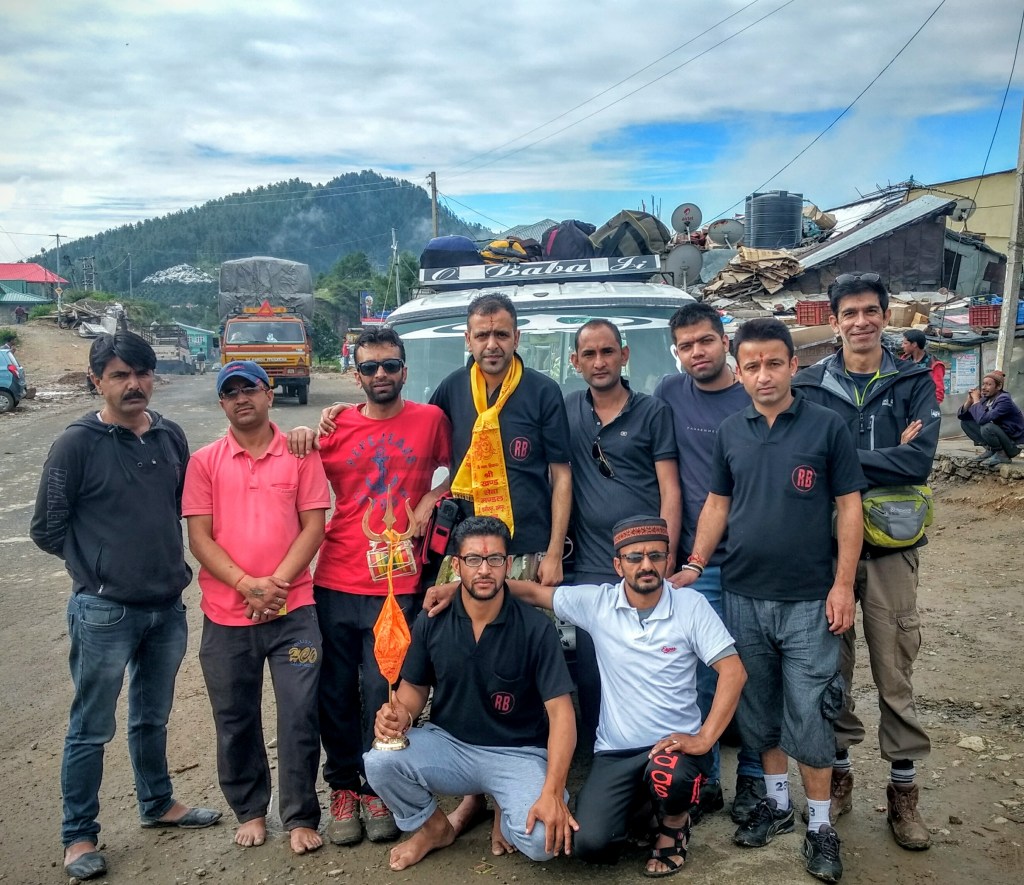
I should be direct about my performance: it was not distinguished. I struggled significantly, stumbled frequently, and arrived at each evening’s camp somewhere between an hour and two hours after the rest of the group, despite starting each day an hour before them. I had proper trekking boots, Goretex layers, trekking poles, and the kind of technical equipment that outdoor retailers present as essential for such conditions.
Four members of our group were barefoot.
This is part of the pilgrimage. The barefoot walk is an offering — devotion made physical, the body’s discomfort offered up as a form of prayer. They moved across slippery mud, sharp pebbles, frozen stream crossings, and sections of glacier without flinching, without cuts or bruises that I could see, without anything in their expression that read as suffering. They prayed before each day’s start. They carried tridents. They sang Shiv bhajans as they climbed — the songs rising and echoing in the thin air above the tree line, entirely serious and entirely joyful at the same time.
In the evenings, once the day’s climbing was done, they were wonderful company. Stories traded across the fire — life in Delhi, life in London, travels in Asia and Europe, the particular comedy of cultures colliding at altitude. They took turns walking alongside me during the harder sections, not making a fuss of it, simply present when the terrain required someone nearby.
The Summit
The final day began at four in the morning.
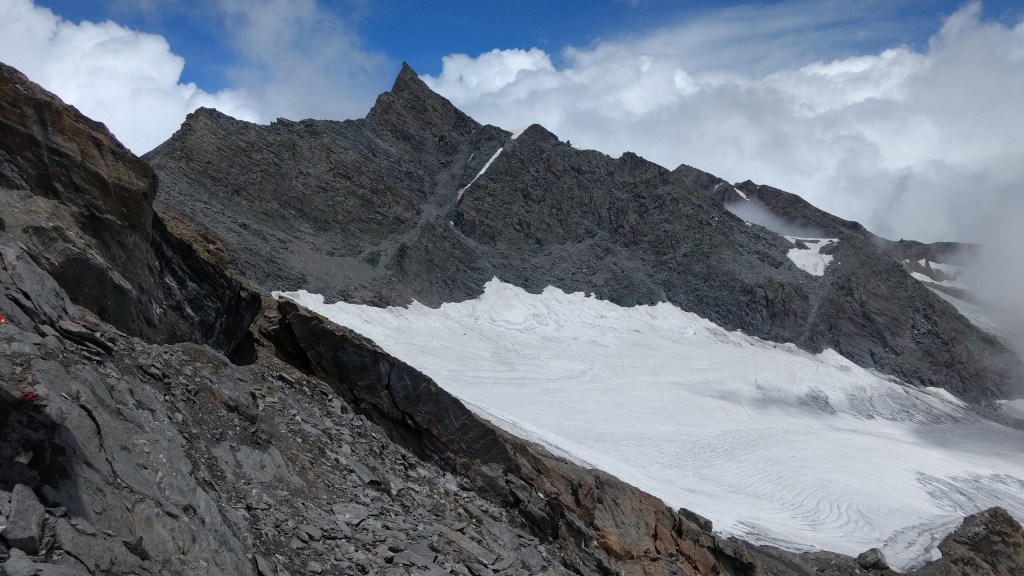
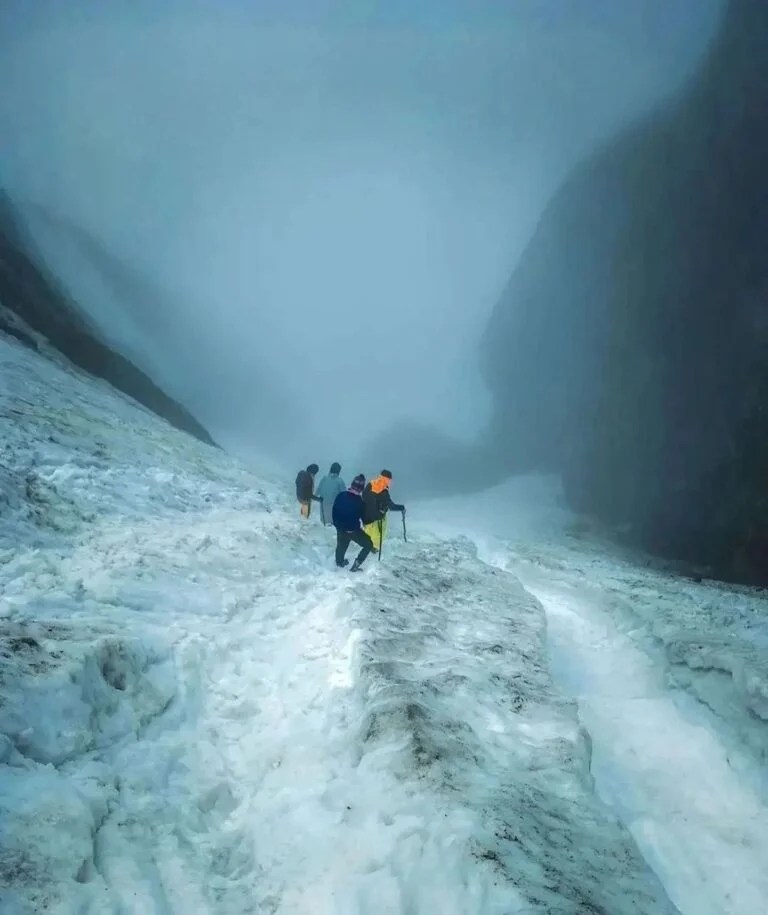
The approach to the summit from the high camp involves a glacier crossing and then a scramble up rocks to the Shivaling itself. I had been warned about the Dunda Dhaar — a ridge so steep it is described locally as the edge of a pole. The description is not an exaggeration. Gravity in that section feels more like a personal adversary.
My companions, guided me across the glacier in turns, pointing out the safest line, waiting at the difficult sections. My clothes were wet. Most of my joints were registering protests. I had fallen enough times to have a thorough and involuntary refresher in human anatomy. And none of that mattered in the slightest.
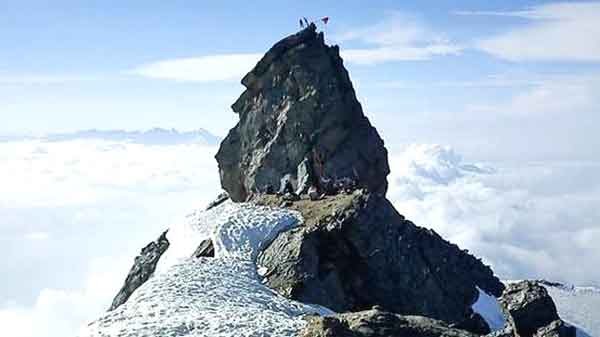
When I reached the summit 6 hours later, and stood before the Shivaling — the great monolith rising fifty metres above the ridge, balanced with that impossible, deliberate poise — I wept. Not from pain or exhaustion, though both were present. From something else. The surrounding peaks filled the horizon in every direction. The air had the particular clarity that only exists above five thousand metres, where everything looks both impossibly close and impossibly vast at the same time. And there was the rock — and there, if you looked with the right patience, was the face. The hairlocks. The nose. The lips. Crude. Unmistakable.
My companions performed the summit pooja – they had started the day empty stomach as part of pilgrimage – food post darshan. They had saved their food — carried it all the way up for the ritual offering — and the person carrying it had turned back in the scrambling zone, forgetting what he was carrying. Half the group had not reached the summit, stopped by altitude sickness, breathlessness or exhaustion. So the pooja was conducted with what we had — trail mix from my bag, shared around a circle of people who had walked barefoot across a glacier to be there.
The clouds were building by midday, which is the mountain’s way of ending the conversation. We turned back.
The descent, in the rain, took the rest of the day. I tumbled more than I walked in certain sections, gravity still enthusiastically unhelpful on the downhill. We reached camp at six in the evening, fourteen hours after setting out.
The Next Step
There is a mantra that my companions offered me early on the first day, when the trail was already harder than I’d expected and we hadn’t yet cleared the tree line. It was simple enough that I could hold it without thinking about it, which turned out to be important.
Don’t look up. Don’t look back. Focus on the next step.
Not the summit. Not the camp you left that morning. The next step. The next breath. Nothing else required. I found that this is genuinely all you can manage at altitude on difficult terrain, and that the constraint, rather than being frustrating, is something close to a relief. The mind, deprived of its usual range of anxious projections, settles into a narrow and surprisingly peaceful present. You are not thinking about how far you have come. You are not calculating how far remains. You are placing your foot on the next available rock and breathing.
It is, I realised, a reasonable description of meditation. The kind that a mountain imposes on you by making everything else temporarily impossible.
The Himalayas have been doing this to people for a very long time. The pilgrimage routes exist because the mountains themselves seem to produce this state — the narrowing of attention, the simplification of purpose, the strange awakening that comes when the usual architecture of worry and planning is stripped back to something much more fundamental. The mythology is the frame. The mountain is the teacher.
I still don’t entirely believe that I made it. When I think about that summit — the face in the rock, the barefoot pilgrims praying in the thin air, the trail mix shared in lieu of a proper offering, the clouds building on the horizon — it has the quality that the best Himalayan experiences always have. Not quite real. Better than real.
— Shrikhand Mahadev, Himachal Pradesh (with gratitude to the friends from Theog who carried me, more or less)


Leave a Reply