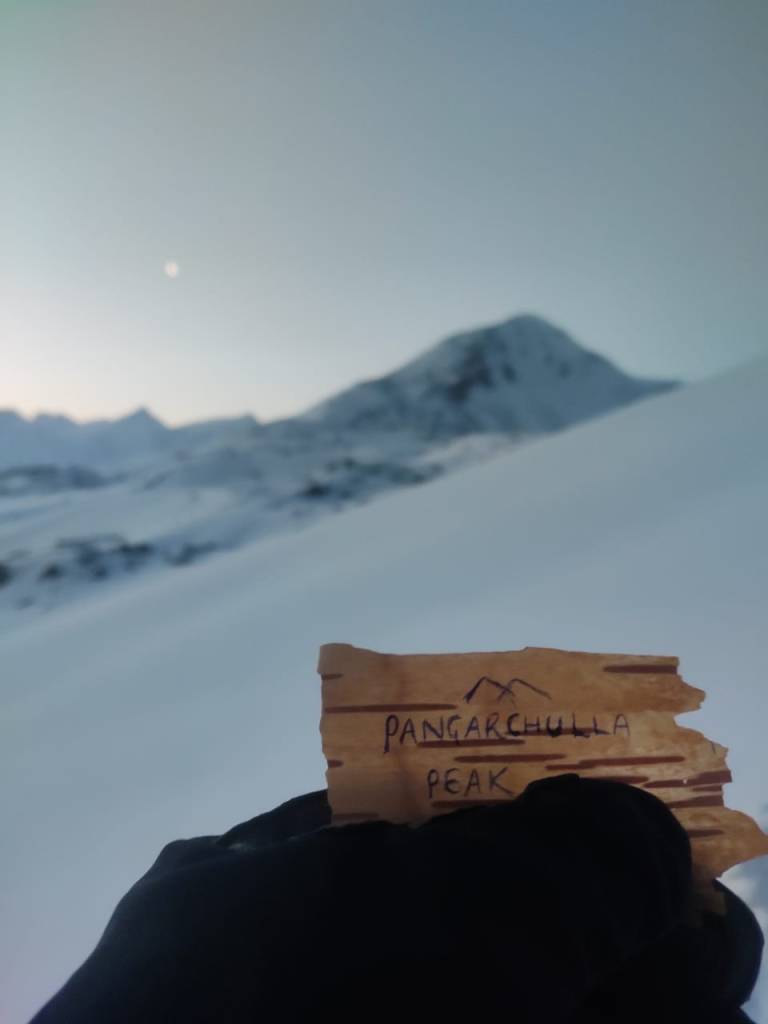
The Wrong Side of Fifty, on the Right Mountain
I was fifty-two years old at the start of this trek, which made me the oldest person in a group of twenty-five. The others were fit, young, and had recently done things like half marathons and high-altitude treks in quick succession — all of which were, in fact, the qualifying criteria for this particular expedition. I had done them too. Just not as recently, and with a complication that I hadn’t entirely disclosed to anyone: eighteen months before, I had badly broken my ankle which still had nails and plates keeping it together, having spent six months in a wheelchair and then on crutches. I had only recently returned to short running and long walks.
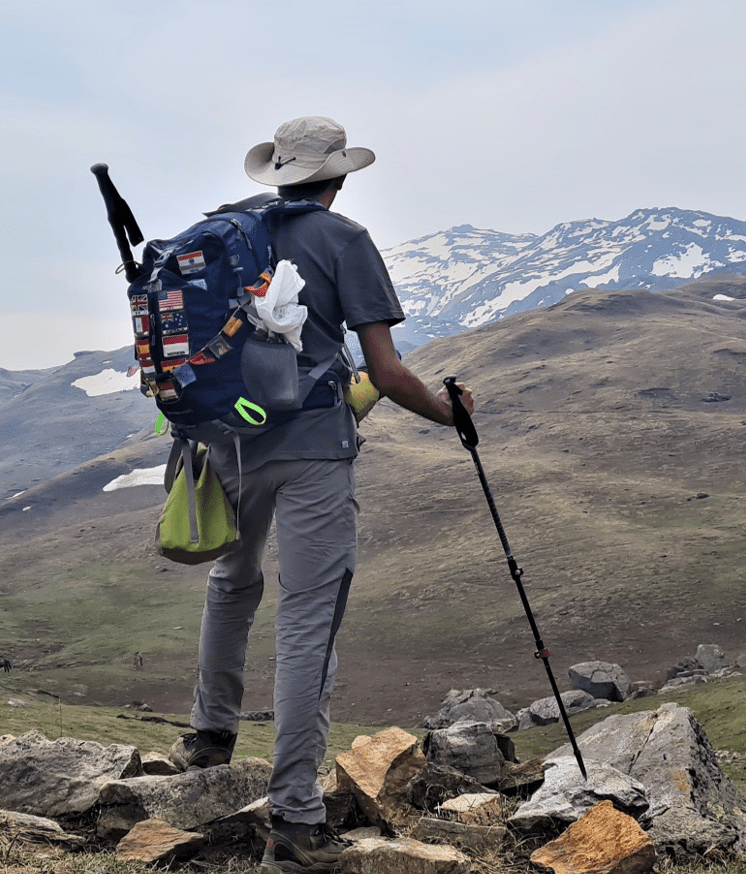
The trek was the Pangarchula Peak Winter Summit — three days from Auli in Uttarakhand to a summit at around 4,500 metres, through snow-covered oak and rhododendron forests, high alpine meadows called bugyals, and a final pre-dawn push to the top in conditions that the organisers described, with some understatement, as challenging. The route follows part of the historic Kuari Pass trail — the Curzon Trail, named for the Viceroy who travelled it in 1905 and publicised it among British explorers, though local shepherds and traders had been using these mountain paths for centuries before his visit. Many of the peaks visible from this route — Nanda Devi, Dronagiri, Kamet — were first measured by the Great Trigonometrical Survey of India, the extraordinary exercise that gave the world its first accurate maps of the Himalayas.
I knew all of this. I also knew, less comfortably, that I was the slow one in a group that needed to move together and that a lagging climber at altitude is not just a personal problem. I signed up anyway. Some decisions resist rational analysis.
The Necklace of Peaks
The approach through the Garhwal Himalayas is one of the more beautiful sequences of landscape I have encountered on any trek. The route moves through a logic that feels almost designed — forest to bugyal, bugyal to ridge, ridge to pass, pass to summit — each stage opening onto the next with the satisfaction of a well-structured argument. The bugyals at Gorson and the high meadows beyond are vast white expanses in winter, the rhododendrons holding their snow-covered branches above the path, and then suddenly — at Phulara Ridge — the mountains arrive.
Not gradually. All at once. A 360-degree panorama of the Garhwal Himalaya that stops you where you stand.
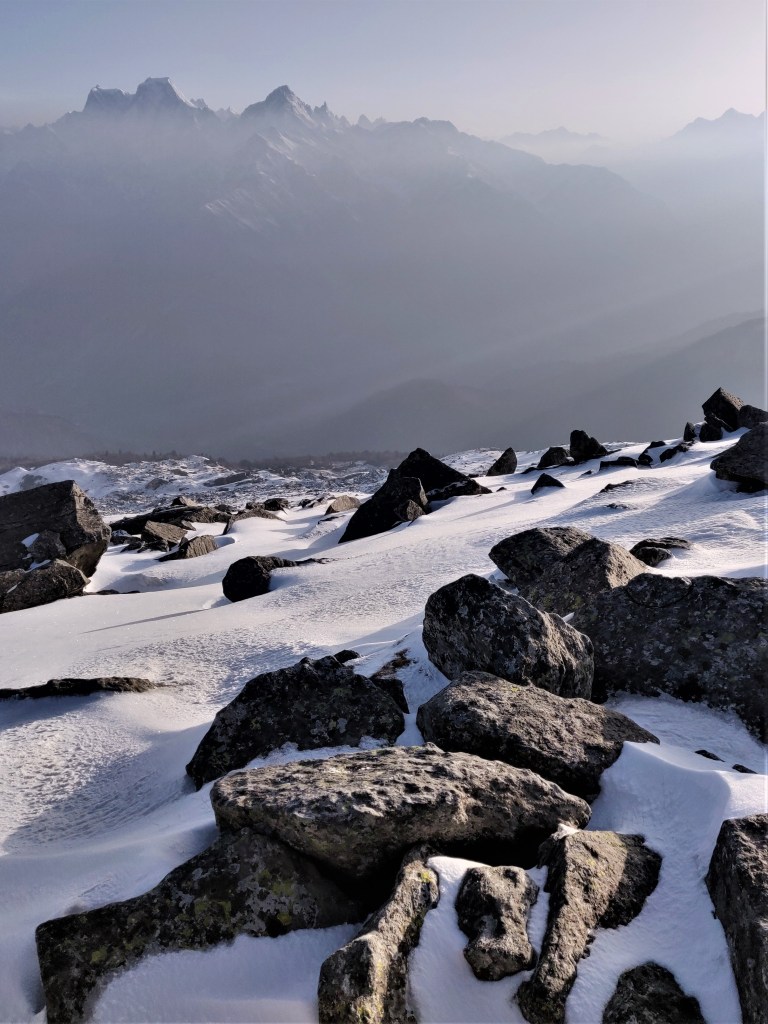
At the centre, unmistakable, is Nanda Devi — the Blessed Goddess, the highest peak entirely within India. For decades in the early nineteenth century, before the Great Trigonometrical Survey completed its work, Nanda Devi’s twin summits were believed to be the highest mountains on Earth. It was the painstaking triangulations of the Survey — calculations made from distant stations across these same ridges — that eventually disproved that assumption and redirected attention northward to what we now know as Everest. She remains, however, the sovereign of this landscape. The amphitheatre of ridges and summits that encircles her — the Nanda Devi Sanctuary — is visible from Phulara Ridge in its full improbable completeness, a natural fortress of rock and ice arranged as though by design around the mother peak.
To the left of Nanda Devi, Dronagiri draws the eye immediately — a bold pyramid with a distinctive notch on its shoulder, a piece conspicuously missing as though bitten away. Local mythology explains this precisely: it was Hanuman who took it, breaking away a section of the mountain to carry the entire Sanjeevani hillside to Lanka so that Lakshmana could be revived. Whether you read this as devotion or geology, the gap in the silhouette is real and unmistakable, and once you know the story you cannot look at the peak without seeing the absence.
To the right, Neelkanth rises in a blaze of blue-tinged ice — a steep pyramidal face with a glacier that catches the light differently from everything around it. The name means Blue Throat, and belongs to Shiva, who earned it at the great churning of the cosmic ocean. When the gods and demons churned the sea of creation in search of the nectar of immortality, what rose first was not nectar but a poison powerful enough to destroy the universe. Shiva swallowed it to save all creation, holding it in his throat where it turned the flesh the colour of deep sky and glacier — Neelkanth.
Further along the ridge, two peaks sit together in a posture so animal that the names seem inevitable. Hathi and Ghodi — the Elephant and the Mare — their rounded summits bent toward each other in the way that large, patient animals bend to graze. Nearby, the soaring double ridge of Kamet catches the high wind, and if you watch long enough you can see why local tradition identifies it with Garuda, the great eagle of Hindu mythology, wings spread and poised as though about to launch from the ridge into the sky above the valley.
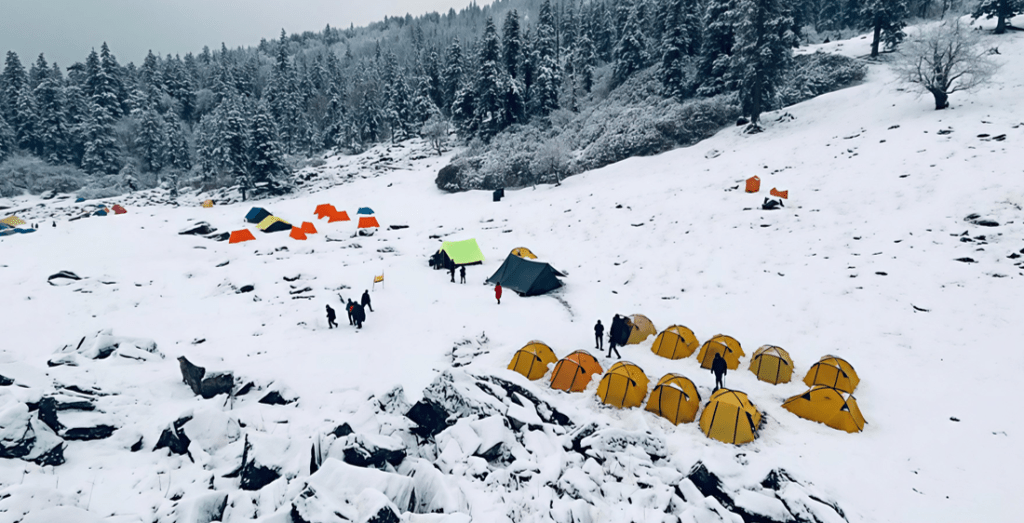
We had a blizzard that evening. Six inches of snow in a sharp spell that collapsed tent flysheets and made sleep a competition between exhaustion and cold. In the morning, the qualification test: a speed ascent to Kuari Pass and back within a set time, to establish whether each climber was strong enough for the main summit push the following day.
The Speed Test, and the Watch List
The logic of the speed test is straightforward and sensible once you understand what the summit night involves. The push for Pangarchula begins at 2 AM. Pitch dark. Multiple groups may be starting simultaneously. At that altitude, in those temperatures, the only way to stay warm is to keep moving — which means a slow climber is not merely a personal inconvenience but a risk shared by everyone in the group. Umpteen stories about Everest, Annapurna, K2 confirmed that the Himalayas have a habit of making their most devastating demands on days when someone in a team was not quite ready. The test exists because of that reality.
I just about made the time to Kuari Pass and back. The wind on the exposed sections was vicious — the kind that gets inside your layers and redefines what actually cold is — and the descent on crampons took much longer than I’d hoped. But I made it. And then came the medical check.
My blood pressure and pulse were elevated. Not dramatically, but enough to put me on the watch list. The trek leader was measured about it: rest, rehydrate, see how the numbers looked before the midnight start. Some others in the group voluntarily stood down. A few were asked not to proceed. I spent the evening willing my cardiovascular system to calm itself, which is not an effective medical intervention but was all I had.
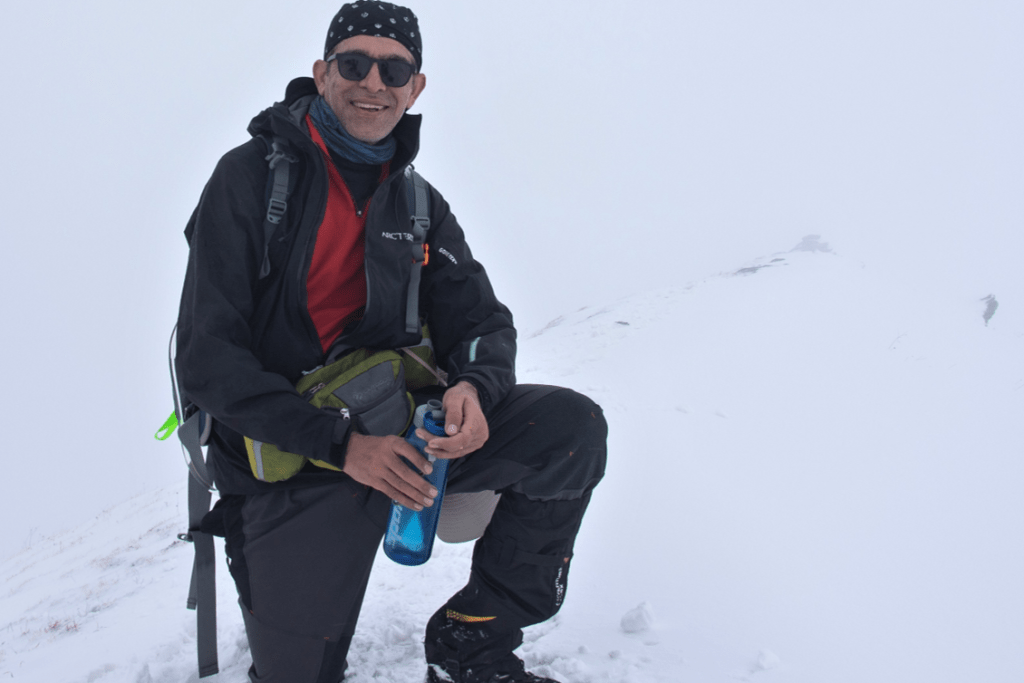
I had packed carefully. A prayer flag. Trail mix for the summit offering — a habit I had carried from Shrikhand Mahadev. And, tucked into the top of my bag, a collection of laddoos from Geeta Bhawan Rishikesh — dense, ghee-rich, almond-and-coconut — which I had been saving as high-protein fuel for the summit morning, rather than the simple poha that was on the group menu.
Two AM, and the Laddoos
Somehow, at midnight, there was no medical recheck. I had my tea, combined the laddoos with the poha in what felt like a sensible fusion of protein and carbohydrate, and assembled with the group in the dark at 2 AM. Bitterly cold. No wind. No cloud. The crunching of crampons on ice and the visible breath of twenty-odd people gathering themselves for what lay ahead.
Within the first hour, I knew the laddoos had been a mistake. The richness at altitude, combined with the effort, produced a heaviness in my chest that was not helping. I had already consumed two of my four litres of water and we hadn’t cleared the Kuari Pass point. The trek leader came alongside and said what needed to be said: if I could not keep the group’s pace, I would need to stop and wait for their return.
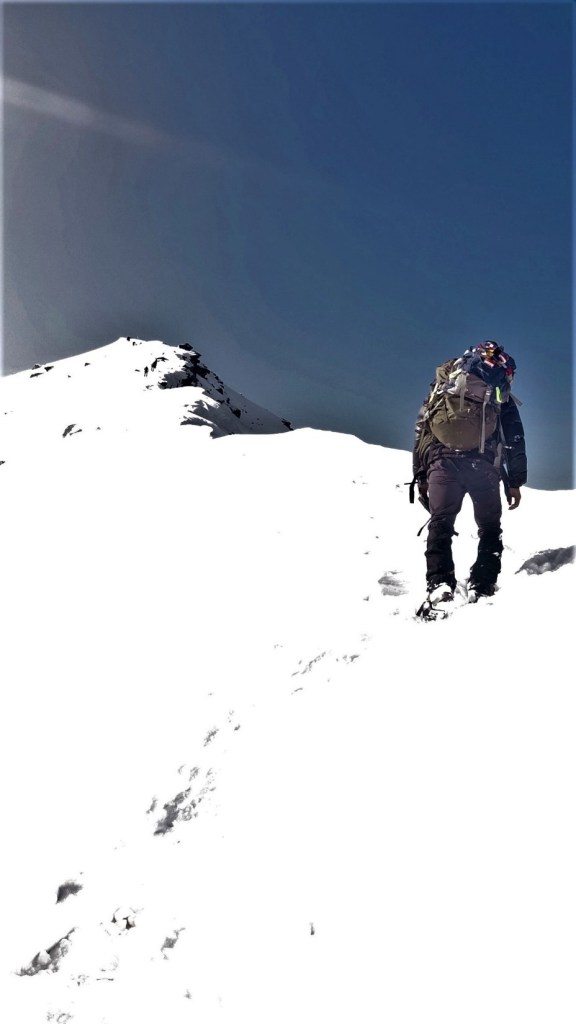
It is a sinking feeling of a very specific kind — the compound of physical distress, altitude, cold, darkness, and the sudden vivid sense of having come this far for nothing. I asked him to take my prayer flag and trail offering to the summit, to make my apologies to the mountain and promise I would return with more strength. He said: let’s see how the next twenty minutes go.
And then I was sick. The laddoos, the anxiety, the altitude — one or all of them — came up at once. And I felt, immediately and absurdly, better. Lighter. As though the mountain had extracted a toll and was now prepared to let me continue.
I continued.
The Walkie-Talkie
An hour later, it was clear I was slow but not slowing down. Consistent, measurable progress. The trek leader handed me the walkie-talkie — a practical decision, so he could monitor me from the front — and said to keep moving. That small plastic object, slightly too large for my jacket pocket, felt like the most significant thing anyone had given me on a mountain.
The lead group, young and strong and well ahead, had heard on the radio that I was struggling, possibly not going to join them on the summit. When they heard I was twenty minutes from the final summit approach, there was a cheer on the walkie-talkie that I still cannot think about without some embarrassment and considerable gratitude. I laboured on and joined them at the base of the final two hundred metres.
All of this was happening while the moon set behind Hathi-Ghodi peak and the first light began to find the edges of Dronagiri. I was not seeing any of this at the time. I was watching the next step, the next foothold, counting breaths. The summit was somewhere above. That was all I needed to know.
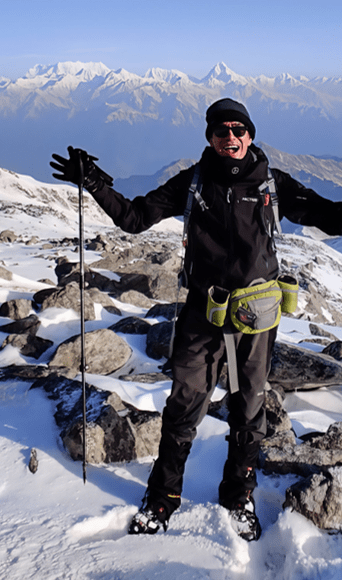
Those final two hundred metres took two hours. Every few steps required a stop. The sun rose fully somewhere in that section, blazing and indifferent, and the landscape that had been mysterious and disorienting in the dark became enormous and clear and heartbreakingly beautiful. We reached the summit mid-morning. I wept, which is becoming a habit at the top.
I tied the prayer flag. I left the trail mix. I thanked the group, and the mountain, and whatever combination of stubbornness and borrowed energy had got me there.
What the Darkness Gives Back
What I had been too focused to observe on the way up, I could now reconstruct in memory and appreciate in full. The light on a high mountain at night moves through a palette that has no equivalent at lower altitudes — and no equivalent in any photograph, because the eye adjusts in real time in ways that a sensor cannot. In the early hours, with the moon still high and the sky crowded with stars, the snow had carried a faint lavender tint, the sky is deep and the ice below it is bright. As the moon began its descent, the lavender cooled to silver, then to pale white, the shadows on the snow hardening and lengthening as the angle of light shifted.
After the moon set there was a brief absolute darkness, when there is no ambient light from any direction and the stars above seem to press downward as compensation. Then, the sky behind Dronagiri began to change. A grey that was slightly less dark than the grey beside it, the outline of the ridge becoming distinct before any warmth entered the light at all. The peaks emerged from this in sequence. And then, in the last minutes before the sun cleared the horizon, the sky above Dronagiri turned a shade of orange so brief— not quite colour, it was more like a sound, a single note played at full volume before the full orchestra of daylight took over. Gold on the summit cornices. Rose on the upper snowfields. The glaciers catching fire in sequence from east to west across the whole amphitheatre, Nanda Devi, her twin summits blazing against a sky that had, in the space of an hour, moved through half the colours that exist.
None of this was visible to me in the way I have just described it. I was counting footsteps in the dark and managing my breath. But the body registers what the attention cannot fully hold, and on the descent, with the effort behind me and the landscape now available to be seen properly, I understood that I had been inside something extraordinary without quite knowing it. The mountains at high altitude are one of the very few places where you have both the time and the conditions to watch light move — no buildings interrupting the horizon, no light pollution narrowing the palette, the thin air making colours sharper than they have any right to be. It is a luxury that requires significant suffering to obtain. I am not sure there is a better argument for the whole enterprise.
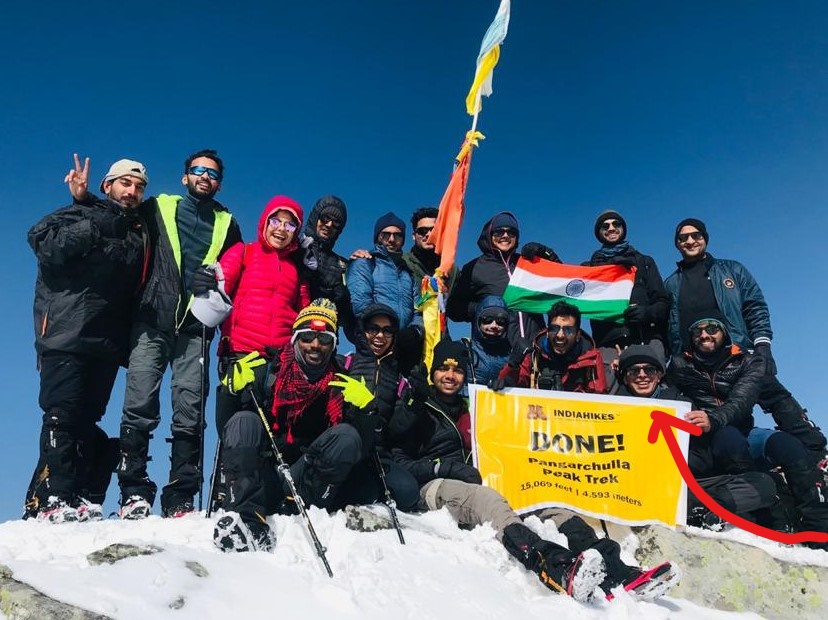
I thought about what this route had meant to different people at different times. The local shepherds who had used these paths for centuries. The Survey of India teams who had carried their instruments through these same passes, measuring what they could. Lord Curzon’s expedition of 1905, which put the trail on a map that the British world would read. And now twenty people from across India, one of them fifty-two years old with a recently healed ankle and a slightly impractical laddoo strategy, finding their way to a winter summit by the combined force of individual stubbornness and collective goodwill.
What I felt entirely clear about at 4,500 metres on a clear winter morning: the mountain does not give the summit. It withholds it until you have offered something in return. The offering is not always the thing you planned. Sometimes it’s a laddoo at 4,000 metres. And sometimes the energy that carries you through is not yours at all. It belongs to the group, to the altitude, to something in the landscape that the surveyed peaks and the named trails and the GPS coordinates have not quite managed to map.
You just keep climbing. The summit, eventually, arrives.
— Pangarchula Peak, Garhwal Himalayas (with gratitude to twenty people who waited)


Leave a Reply