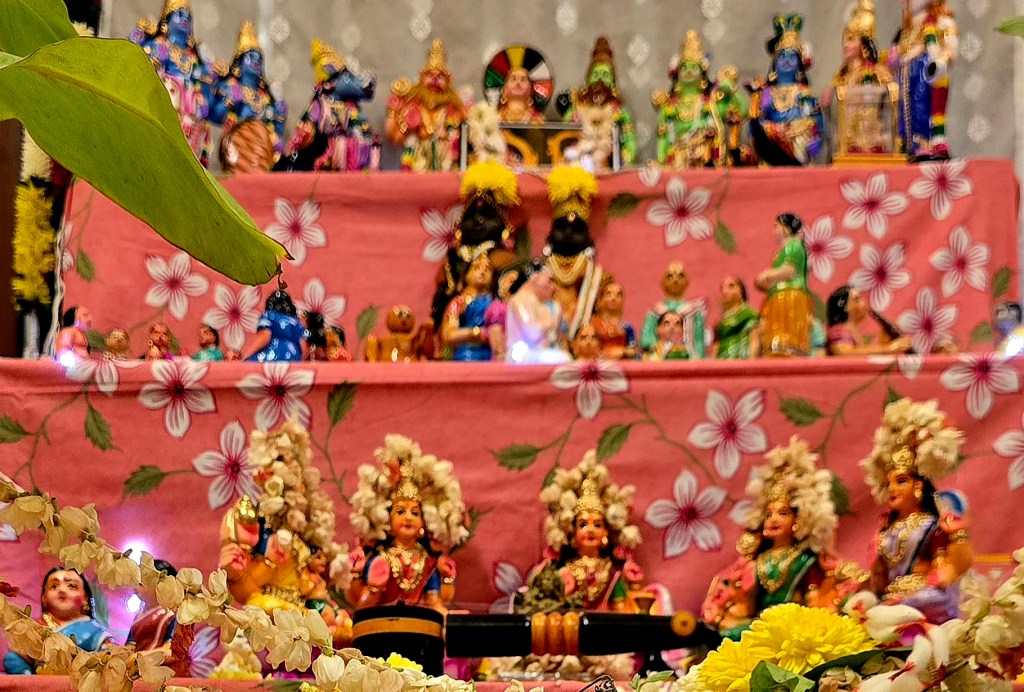
After writing about modaks at Ganesh Chaturthi and sweets at Diwali, and fish at Durga Puja, I thought I’d seen most of what Indian festivals could offer in the way of food and spectacle. But that illusion evaporated the moment I stepped into my friend Sam’s home in Gurgaon for what she called Bombe Habba — the festival of dolls.
Now, I had heard of Dussehra and Navaratri, of lamps, prayers, and goddess worship, but this was something else altogether. As soon as I entered, I was greeted by the fragrance of sandalwood incense mingling with something distinctly edible — a smoky, spicy aroma that later turned out to be gunpowder (the roasted lentil-and-chilli condiment, not the explosive one). Somewhere in the background, mantra recitation with prayer bell chimed, and laughter echoed from the kitchen.
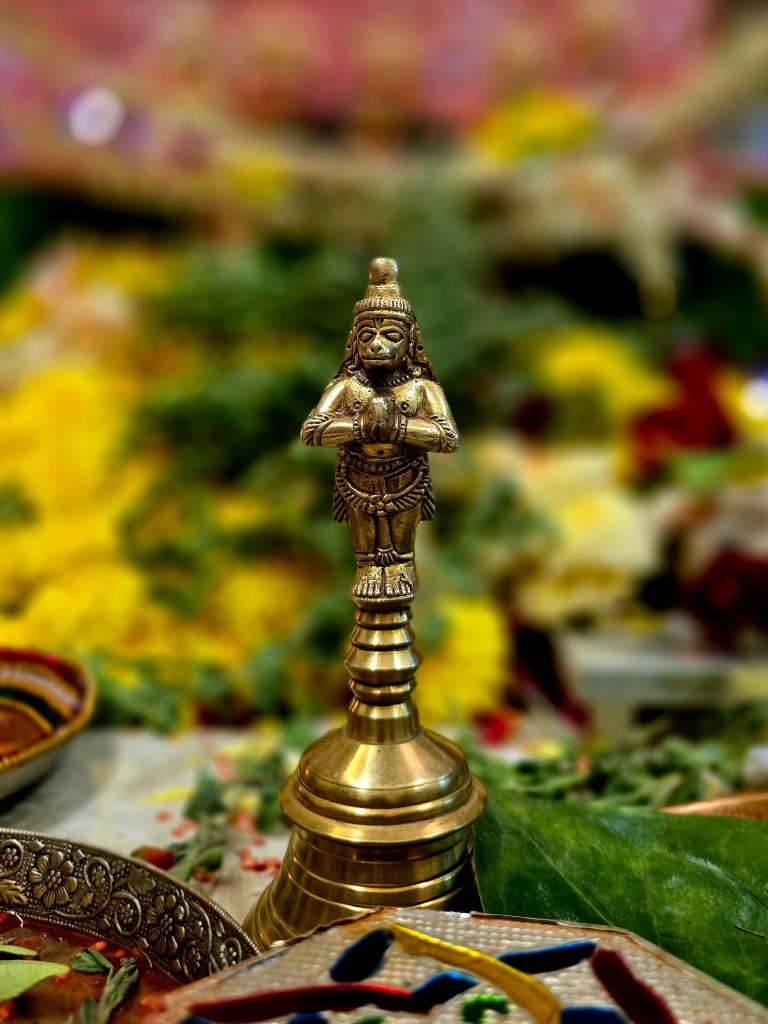
Sam appeared, radiant in a long silk saree that shimmered in jewel tones, her braid crowned with jasmine flowers. The blossoms added their own soft perfume to the air — that unmistakable mix of devotion and domesticity that defines so many Indian festivals. “Welcome to our Bombe Habba!” she announced, her eyes twinkling. “Today you’ll see stories, and you’ll eat stories.”
The Living Staircase of Dolls
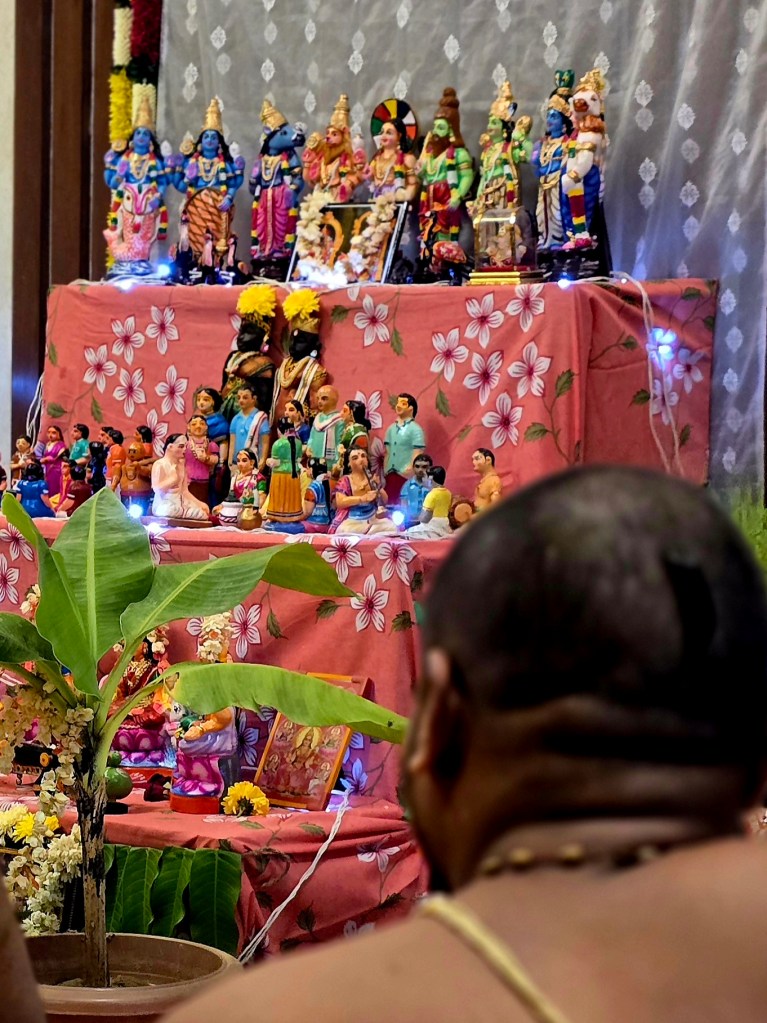
And then — the Golu itself. The Golu (or Bombe Habba) display occupied pride of place in the living room. Imagine a staircase built just for dolls, each step brimming with colour, myth, and whimsy. At the centre, the gods held court: Ganesha with his cheerful belly, Saraswati serene with her veena, Lakshmi radiant and scattering prosperity. Each was perched on their vahana (mount) as if ready to take off on a cosmic adventure.
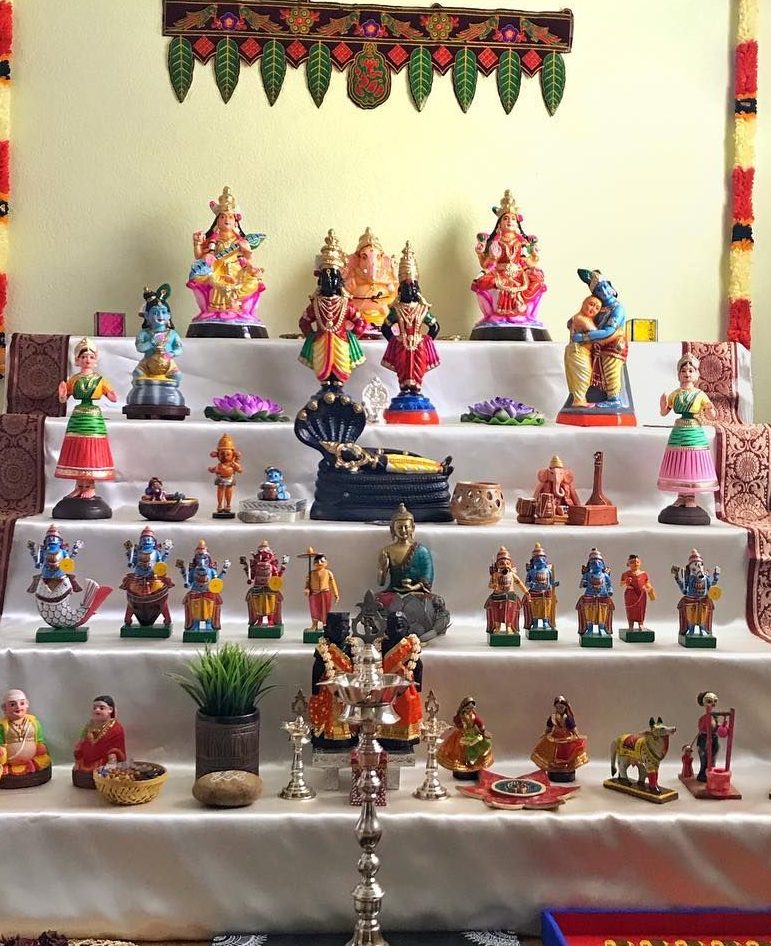
One tier up, the avatars of Vishnu stood frozen mid-legend. There was the fish who guided humanity through a flood, the tortoise holding steady during the churning of the ocean, and the half-lion, half-man who leapt forth to save his devotee. Krishna twirled his flute, Rama steadied his bow — it was mythology in miniature, all in one place.
But Sam’s family had gone a step further — there were Lakshmi’s many avatars too, each representing wealth, courage, wisdom, and grain. “She’s the reason we don’t run out of rice,” Sam joked, pointing to the Dhana Lakshmi figurine. And tucked among the gods was Vitthal — the beloved form of Vishnu worshipped in Maharashtra and Karnataka — standing alongside his consort Rukmini, both smiling serenely as if enjoying the mortal chaos below. This is the first set my parents started the collection with she said.
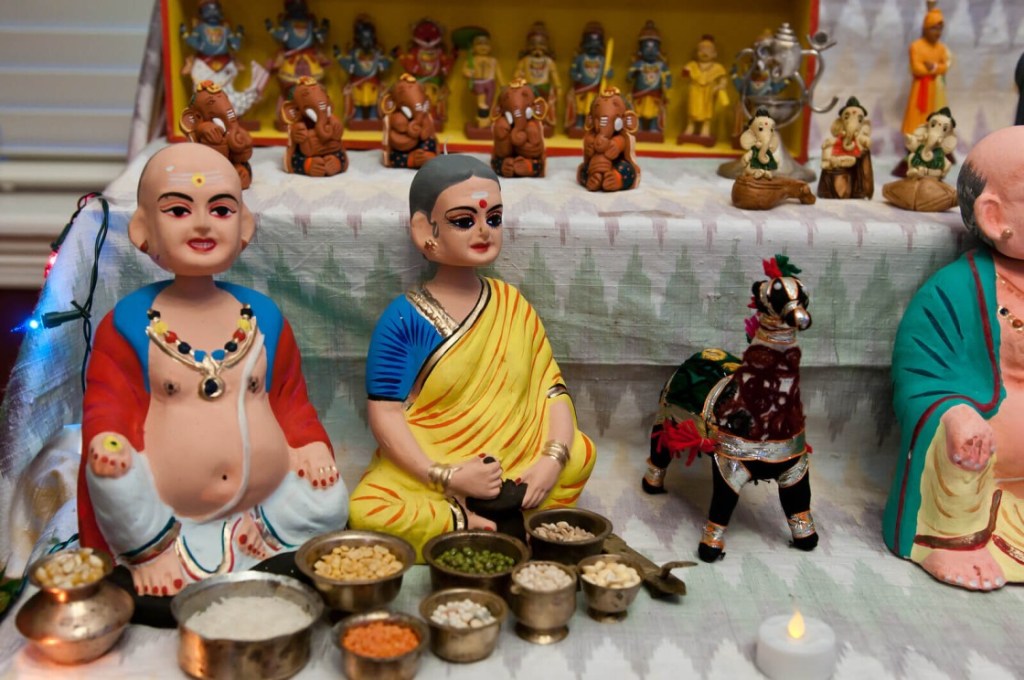
Then came the surprises. A Karhakali dancer with a dangling head — perpetually mid-twirl, her balance eternally questionable. And an old, round-bellied couple made of clay, sitting together like the veterans of many festivals, watching the world go by with contentment. Sam laughed, “That’s my grandparents’ favourite pair — my grandfather says that’s how he and grandma will look when they retire for the hundredth time.”
Below them were miniature village scenes — women balancing pots of water, farmers ploughing their fields, a schoolteacher with tiny students arranged in front of a blackboard. It was a world within a world. Every figurine had a story. “This one,” Sam’s mother said, pointing to a dancing Krishna, “was bought the year Sam was born.” Another was from their trip to Madurai; one had been rescued from a broken set; another gifted by a neighbour who had moved abroad. Each doll had a memory, a time stamp, a person attached to it — a museum of affection arranged neatly in terracotta and paint.
Every year, a new doll joins the family — ceremoniously unwrapped, admired, and assigned its rightful spot. The entire process, I realised, wasn’t just decoration — it was ritual, storytelling, and heritage all rolled into one, held together by laughter and shared memory.
A Story Within a Story (Or So They Said)
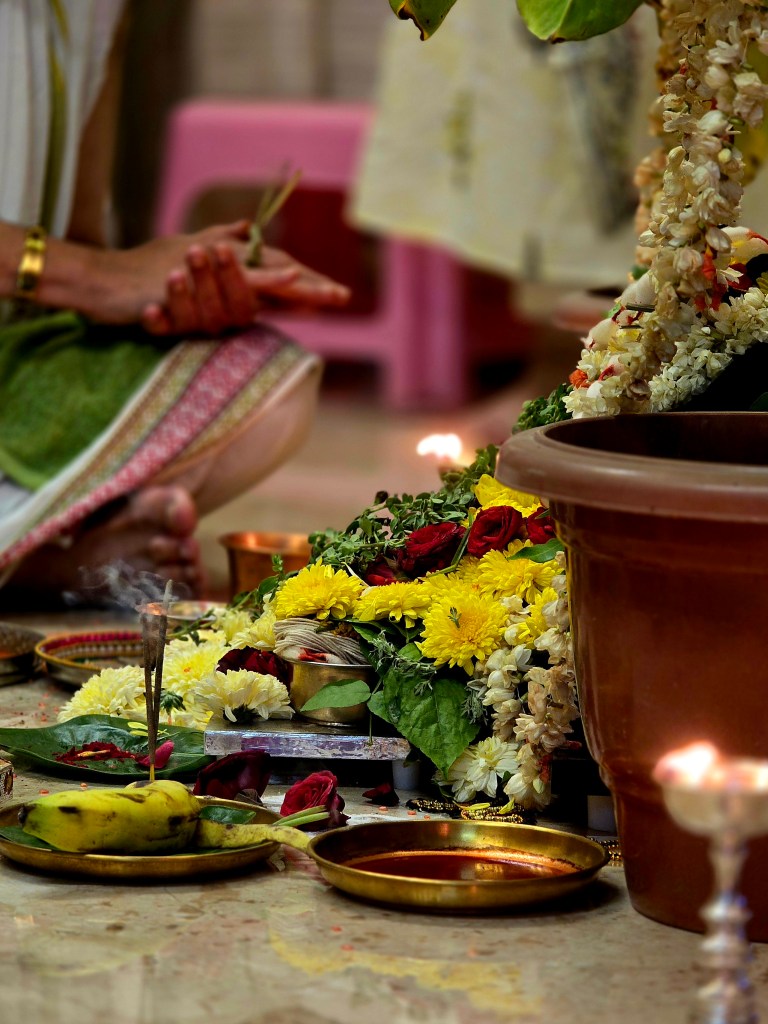
The evening wasn’t just about dolls. The evening was also Sam’s families annual ritual of performing a SatyaNarayan Katha, two purohits sat cross-legged on mats, textbook Brahmin priests — shaven heads, long tufted bodis, crisp white dhotis, and an air of calm concentration.
From what I could gather, the story was — well — a story around a story. Someone attended the narration and prospered; another left midway and faced ruin. Attend the ceremony, gain blessings; skip it, and you risk cosmic losses. It was divine storytelling with a moral ledger.
Except, somewhere between “he gained immense wealth” and “he lost his kingdom,” I lost the plot as the fragrance of the prasad being prepared — warm semolina, ghee, sugar, and banana — was frankly more persuasive than the sermon. And then came the unmistakable scent of roasted gunpowder — the beloved South Indian spice mix of dal, chilli, and sesame — drifting in from the kitchen like a culinary alarm clock for the hungry.
Achar Ke Vichaar and the Feast That Never Ends
Finally, the prayers ended, the lamps were waved, and the gods thanked. That’s when Sam’s father took charge — part chef, part host, part philosopher, and known affectionately in their circle as Achar ke Vichaar (“Mr. Achar’s Thoughts”). “Please sit,” he declared, “the story of the stomach must now begin!”
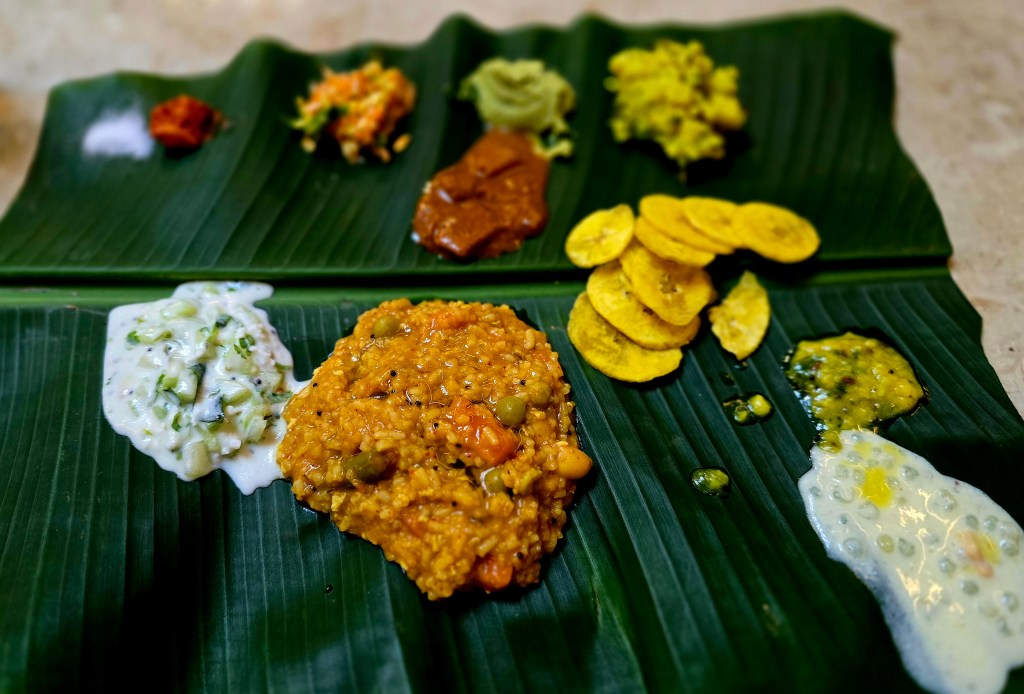
We sat cross-legged on the floor, banana leaves unfurled before us — a sight that still makes my heart flutter with anticipation. The meal began, as all good South Indian meals do, with a riot of sides: a tangy lemon pickle that tingled awake every taste bud, kosambari (a chilled salad of soaked moong dal, cucumber, and coconut), cucumber raita, and a small mound of coconut-mint chutney.
Then came the star of the show: steaming bisi bele bath — rice, lentils, tamarind, and spice melting into each other in a glorious orange-gold harmony. The aroma alone was enough to convert anyone to Karnataka cuisine. Alongside it came sabudana kheer, banana chips that shattered delicately between your teeth, and soft, steamed lentil vadas.
Just as I thought we had reached the end, a second course appeared. Rice with ghee and rasam — thin, tangy, and comforting. Then rice with roasted gunpowder and a drizzle of ghee. Then rice with curd. Somewhere between the third and fourth round, I realised that South Indian feasts are like generous relatives — they never really end.
By the time the dessert arrived — soan papdi, flaky and melting, tasting like spun sugar dreams — I had no space left. I had also lost track of time, the number of courses, and possibly my ability to move. My notebook, however, was filling up fast.
The Taste of Affection
What struck me most wasn’t just how delicious everything was — though it was truly, dangerously delicious — but how personal it all felt. Every dish carried pride and memory. The bisi bele bath was made using Sam’s grandmother’s recipe; the pickle had a story about a mango tree that refused to fruit for years; the rasam was from a neighbour’s tradition that had somehow joined their own. It wasn’t just a meal — it was oral history told through food, laughter, and love.
The warmth of it all — the way everyone pitched in, how guests became family, made me realise something important. What makes these festivals extraordinary isn’t the grandeur, but the generosity.
A Celebration of Stories
As the evening wound down, I returned once more to the dolls. In the gentle lamplight, they looked almost alive — Saraswati’s veena glimmered, Lakshmi’s coins sparkled, and Vitthal seemed to smile knowingly at the last few guests lingering over coffee. The Karhakali dancer’s wobbly head nodded approvingly, as if to say, Yes, another good year, another good meal.
Every figure in that display had its own place, its own backstory, and its own affection attached to it — from the grand deities to the humble clay couple who’d seen more festivals than I ever would. That, perhaps, is what Bombe Habba is really about: a celebration of continuity. Of stories told and retold, of dolls passed down through generations, of recipes perfected over years, and of the joy that comes from sharing them — generously, noisily, and lovingly.
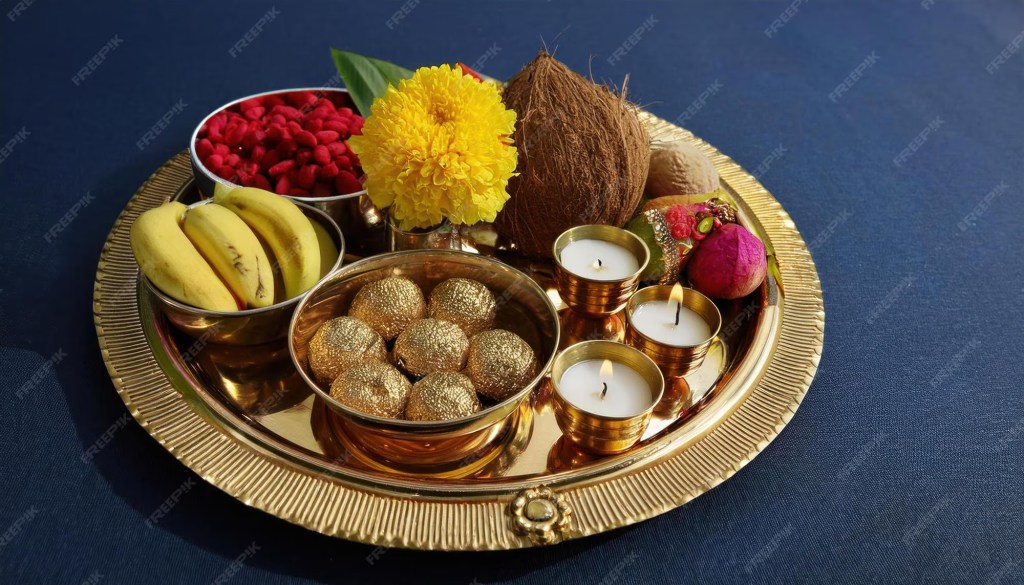
When I finally left, full and happy, Sam handed me a small packet of prasad. “For later,” she said. I smiled. Later came sooner than expected — I couldn’t resist tasting it on the ride home. It was sweet, ghee-slicked, and comforting, just like the evening itself.
And as I wrote down my notes that night, I realised that the story of Bombe Habba isn’t really about dolls at all. It’s about people — their quirks, their warmth, their traditions, and their incredible ability to turn a simple evening into a feast of memories.
 Poyekhali !
Leave a comment