My Pujo story: finding Durga in Delhi and surviving the CR Park adventure
If you’ve read my earlier post Banana Leaves, Modaks and Tight Belts, you’ll know I measure festivals as much by what’s on my plate as what’s on the calendar. This September, that experiment took me to Chittaranjan Park in Delhi — the beating heart of Bengali life in the city, and during Durga Puja, a full-blown sensory festival where food, faith, music, and smoke all collide in glorious chaos.
After a two-hour drive for just 21 kilometres, most people would be frazzled. Not us. With our workmate Smita — probably the only brave Bong gal who insists CR Park is better than Kolkata — we were more energised than ever. Smita’s confidence wasn’t misplaced. By the end of the night, I realised she might just be right.
Pujo Lesson #1: Never underestimate a Bengali’s conviction — or their stamina for traffic and sweets.
The City Within a City: Delhi’s Little Kolkata at Pujo Time
Stepping into CR Park in the early evening is like entering a parallel universe. Streets glow brighter than Diwali, every corner bursting with colour, sound, and the aroma of frying snacks. Kids dart past carrying phuchkas, somehow not spilling the tamarind water (too much). Aunties in crisp cotton and uncles in starched kurta-dhotis swap a year’s worth of gossip. Couples wander hand in hand, stopping to admire pandal artistry and snap those Insta selfies. And somewhere nearby, a dhaki drummer — who looks like he hasn’t slept in nine nights — summons the goddess with every thunderous roll of his drum.
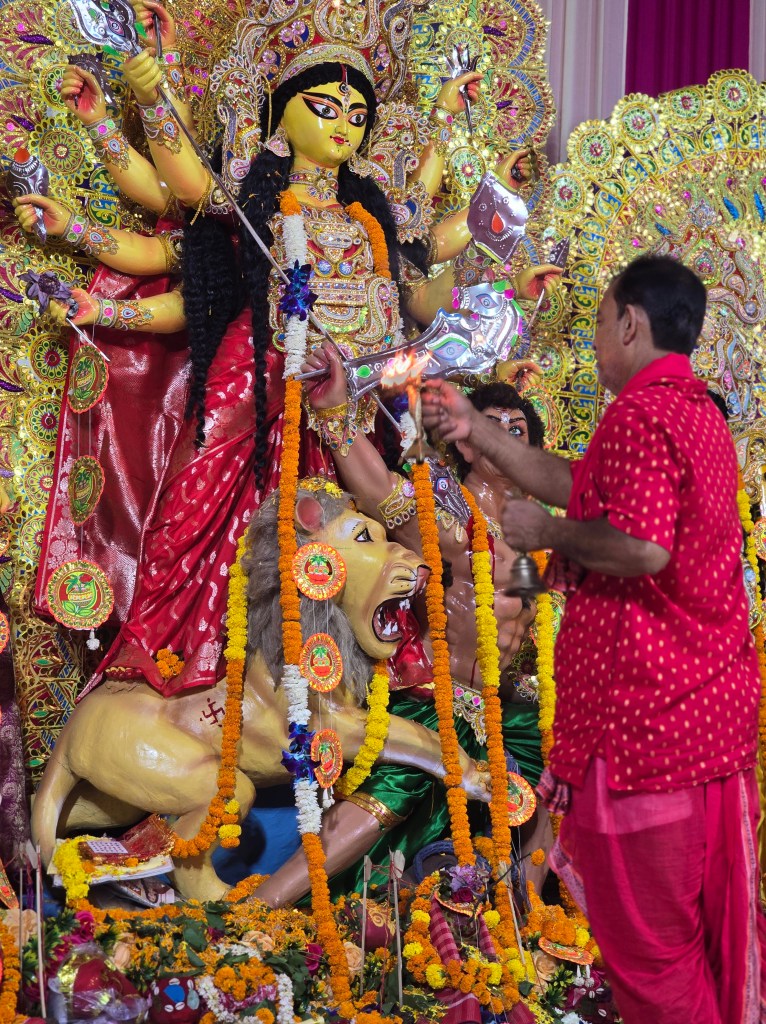
I tried to play it cool, but within five minutes I had marigold petals in my hair, incense smoke in my lungs, and the overwhelming urge to join the aarti despite not knowing a single mantra. That’s CR Park’s magic: resistance is futile. The pandals pull you in, and suddenly you’re part of the celebration.
Our first stop was Smita’s local pandal, where the Sandhya Aarti at Milan Apartments was homely, intimate, and utterly beautiful. I even got introduced to Mrs Lord Ganesh — lovingly called Kola Bou — a banana tree wrapped in a saree. (Apparently, Ganesha married a banana tree to assure his mother she’d always be well-fed. A clever, sustainable, argument-free solution.)
Smita’s parents made sure we were looked after, and all fatigue melted away the moment we tasted the prasād. The sandesh evaporated on the tongue like sweet perfume, the narkel bora (coconut fritters) crunched and melted, and the banana-jaggery laddoo was pure bliss.
Pujo Lesson #2: If the goddess doesn’t get you, the sugar will.
The Story Behind the Festival: Durga & Mahishasura
Let’s build some appetite with background mythology, so you don’t look clueless while queueing for bhog.
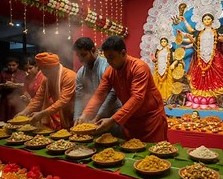
Once upon a time, a demon named Mahishasura performed such long and painful penance that the gods had to grant him a boon: no man or god could kill him. Empowered and arrogant, he began terrorising heaven and earth. Desperate, the gods pooled their powers to create Durga, the ultimate warrior goddess. She arrived armed to the teeth — Shiva’s trident, Vishnu’s discus, Indra’s thunderbolt, plus bows, swords, and more. Ten arms, a lion mount, and an aura that screamed: Game over.
For nine nights, Mahishasura tried every trick — changing forms, charging, deceiving — but finally, Durga pierced him in his buffalo form with her trident. Order was restored; cosmic balance achieved.
Never underestimate a goddess with ten arms — or ask a Delhi Bengali uncle if they should only be considered half bengali
But in Bengal, the story has a softer layer: Durga is also a daughter returning to her parental home. She never arrives alone — Lakshmi, Saraswati, Kartikeya, and Ganesha accompany her. That’s why Durga Puja feels as much like a homecoming as it does a battle victory. It struck me how much Pujo feels less like solemn worship and more like hosting family for a long weekend — complete with arguments over food.
Pujo Lesson #3: Even goddesses travel with family — and extra luggage.
Rituals at CR Park: A Symphony of Sound, Smoke, and Spectacle
If mythology gives you context, the rituals give you goosebumps. At CR Park, devotion unfolds through sound, sight, and scent — each moment pulling you deeper.
- Pushpanjali (Morning Offering): Devotees clutch flowers and bel leaves, chanting before laying them at Durga’s feet. It looks like a synchronised yoga session but with marigolds instead of mats. Petals fly in all directions — proof that devotion isn’t always tidy.
- Bhog (Community Feast): By midday, the goddess is offered food first, then everyone shares it. Expect steaming khichuri, labra (mustard vegetables), chutney, and payesh (rice pudding). The lines are long, but no one minds — everyone’s plotting how to sneak seconds.
- Sandhya Aarti (Evening Prayer): The ritual that hooked me. Lamps waving in arcs, conches blowing, incense turning the air to mist, and dhak drums pounding until your heartbeat syncs. Women sway with clay pots of burning incense (dhunuchi naach), faces glowing in the firelight. At CR Samiti’s 50th Puja, one dhaki even climbed a tower of drums and played like a rockstar. The crowd went wild.
- Sandhi Puja: The most dramatic moment, right at the cusp of Ashtami and Navami. 108 lamps lit, 108 lotus flowers offered — this is when Durga killed Mahishasura. The energy in the pandal is electric, reverent, theatrical.
- Sindur Khela (Vijaya Dashami): On the final day, married women smear vermilion on the goddess and then on each other, laughing through tears. Think Holi in red, but with white saris and divine grace. I missed it this year — which only means I have a reason to return.
Pujo Lesson #4: Faith, like smoke, lingers long after the lamps go out.
Pandal Hopping: Homely, Thematic, and Theatrical

Armed with prasād-fuelled enthusiasm, we set off — first Kali Bari, then K Block, and finally the grand one: CR Samiti’s 50th Durgotsava.
Each pandal was a world of its own. Some stayed traditional with clay idols and terracotta backdrops. Others went full theme park — one recreated Tagore’s Sonar Bangla, a meditation on illusionary wealth built into a temporary temple.
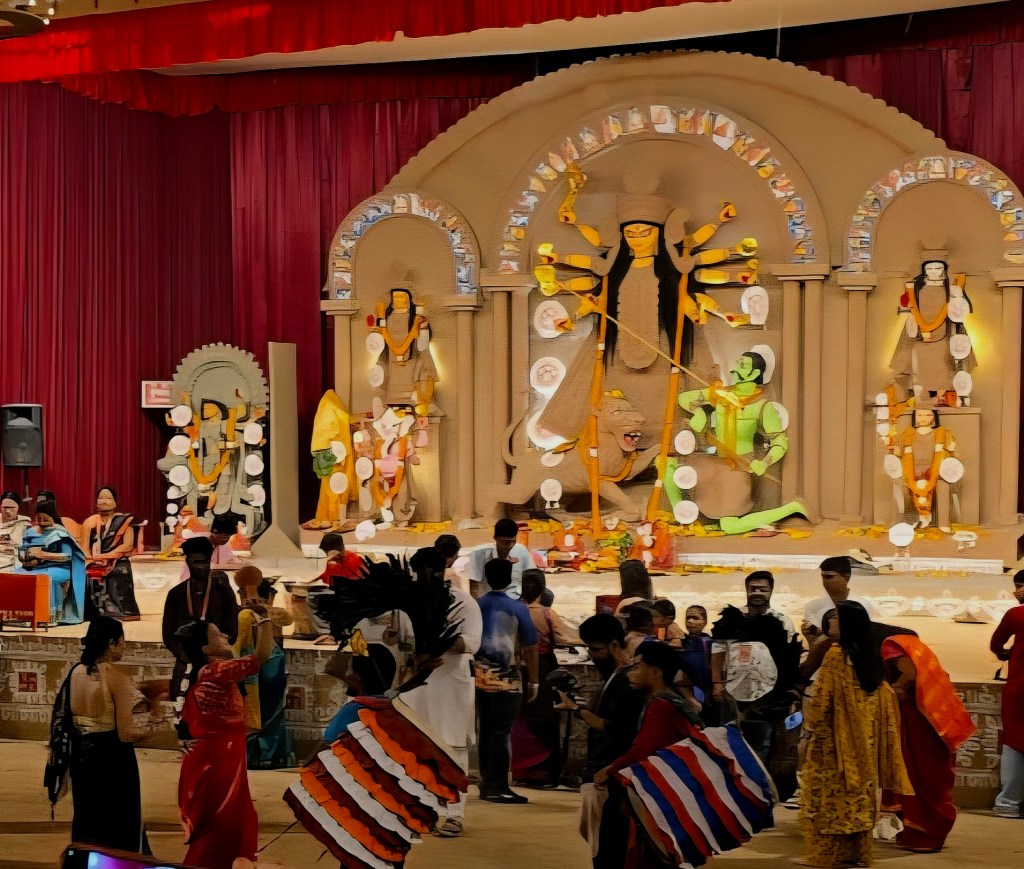
But CR Samiti took the crown. Twenty idols stood beneath a canopy framed with exquisite Bankura terracotta tiles, guarded by giant Bankura horses. When the dhak and ghanti (bells) began, smoke swirled, incense filled the air, and the idols glowed gold under the lights. For a few minutes, it felt like sensory nirvana — sound, sight, and spirit colliding.

And then, predictably, the smell of frying fish pulled me back to earth.
Pujo Lesson #5: The divine may be eternal, but the fish fry waits for no one.
Food, Glorious Food: CR Park Edition
Let’s be honest — Pujo is half prayer, half food festival.
The pandals lure you in with devotion, but the food stalls keep you there.
- Phuchkas: Forget Delhi’s golgappas. Bengali phuchkas are sharper, tangier, and more addictive. By my third round, I was pledging loyalty to the vendor like he was my spiritual guru.
- Chops & Cutlets: Potato, beetroot, or fish — crumb-coated and fried golden. They vanish faster than you can say cholbe na (“won’t do,” which ironically means “absolutely yes”).
- Rolls: Flaky parathas rolled around mutton, chicken, or egg, dripping with chutney and oil. They will ruin your white kurta, but you won’t care.
- Bhetki Fry: Stuffed with mint chutney, crisp and juicy — the kind of bite that makes you pause mid-sentence.
- Mutton Kosha with Luchi: Deep, spicy, slow-cooked perfection paired with cloud-like fried bread. Every Bengali I met said this dish alone was worth the traffic jam. They were right.
- Bengali-Chinese Shrimp Chilli: Spicy, saucy, and absolutely addictive — a reminder that Bengalis have perfected Chinese food better than most Chinese restaurants.
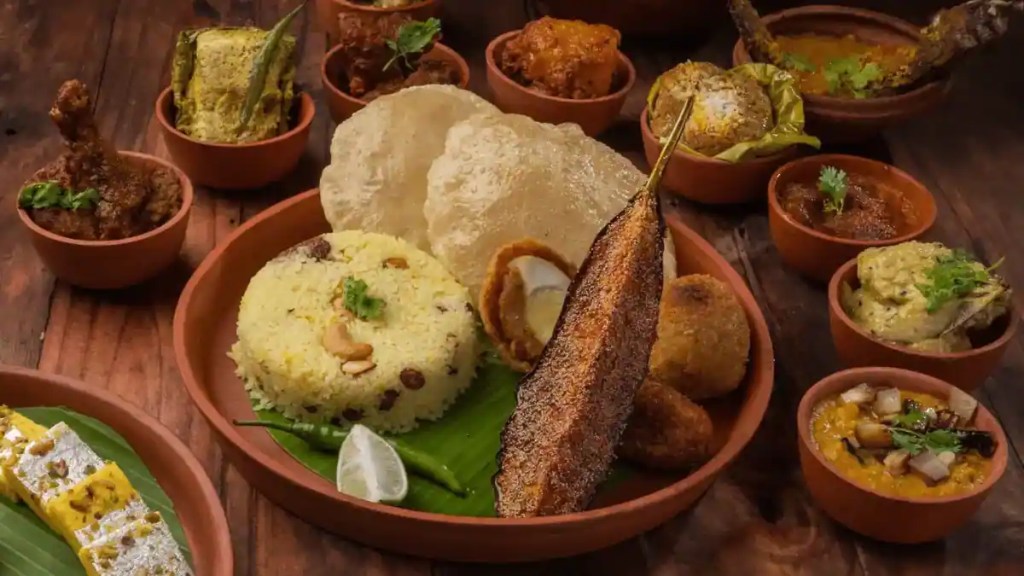
We ended with chai in clay cups and a sweet paan that wrapped the meal like punctuation. If devotion fills your soul, CR Park’s food stalls fill your stomach — both equally necessary.
Pujo Lesson #6: You can pray standing up, but true worship begins at the food stall.
Why It Matters
At the end of the night, full from both prasād and a dozen food stalls, I realised what makes CR Park so special. It isn’t just the artistry, the dhak beats, or even the food (though that comes close). It’s the sense of belonging — every pandal feels like stepping into a giant community living room.
I may have missed Sindur Khela and the Ilish Bhaat feast, but that’s the beauty of Durga Puja. You always leave something to come back for.
Smita was right — CR Park during Pujo really is its own universe. A blend of devotion, theatre, and food safari. A festival where gods and humans, incense and cutlets, all share the same space.
Pujo Lesson #7: Long live the bhadra log — and the sacred balance of dhak beats and bhetki fry!
So this is my Pujo story — of finding Durga in Delhi and surviving the CR Park adventure.
A tale of ten arms and two thousand calories, of sandesh to phuchkas, mutton kosha and the unmistakable taste of home. Of the dhak’s heartbeat and incense smoke, of dhunuchi dancers and frying fish, of lights, the lion goddess, and her entire divine entourage — not to mention half of Delhi’s Bengali community.
Sensory nirvana, indeed.
 Poyekhali !
Leave a comment