Once upon a time, a humble little fruit set sail across the seas and forever changed the way the world eats. No, it’s not some exotic, rare delicacy, but rather a fiery ingredient that has become an essential part of kitchens from Mexico to India and beyond—the chili pepper. This small but mighty berry, ‘yes, a berry’, has had an explosive influence on global cuisine since it first hitched a ride on trading ships about 500 years ago. Its journey is not just about spreading heat and flavor but is also a fascinating tale of trade, migration, and cultural exchange that has shaped modern history.
The Columbus Conundrum: Mistaking Chilis for Black Pepper
In 1492, Christopher Columbus set sail across the Atlantic Ocean, famously aiming to find a new route to India in search of spices, particularly black pepper, which was highly prized in Europe. His voyage, of course, didn’t lead him to India but to the shores of a new continent altogether. Unaware of this monumental discovery, Columbus mistakenly referred to the indigenous people as “Indians,” a name that, while problematic, persists to this day.

Chili’s Mysterious Origins: A Spicy Beginning
The chili pepper’s true origins lie deep in South America, where it evolved as a defense mechanism against predators. The heat of chili peppers comes from a chemical compound called capsaicin, which is designed to deter animals from eating the fruit. Interestingly, one group of animals is immune to capsaicin: birds. And these feathered travelers played a key role in spreading chili seeds far and wide, from the jungles of the Amazon to the highlands of Mexico.
Thanks to these avian carriers, chili peppers were already growing across a broad range of climates in South and Central America by the time Columbus arrived. Whether in Ecuador, Bolivia, Brazil, or the Caribbean, chilis were thriving, and indigenous peoples were incorporating them into their diets with gusto. However, no ancient society embraced the chili pepper quite like the people of what is now Mexico. There, chili peppers became a cornerstone of local cuisine, used in everything from stews and sauces to sacred rituals.
The Spanish and Portuguese: Rivalry on the High Seas
Fast forward a few years after Columbus’s first voyage, and the race was on between two European powers: Spain and Portugal. The Spanish, having laid claim to much of the Americas, were focused on plundering its riches, including precious metals and, of course, chili peppers. The Portuguese, on the other hand, were less interested in conquest and more focused on building a vast global trade network. Their ships crisscrossed the oceans, establishing colonies and trading posts in Africa, Asia, and South America.
The Portuguese made landfall in the Americas in 1498, just a few years after Columbus, and soon began exporting chili peppers from Brazil. However, these were not the same chili species that Columbus had encountered in the Caribbean. The Brazilian variety was Capsicum frutescens, which would spread far and wide through Portuguese trade routes. This chili would go on to influence cuisines in Mozambique, where it became known as Peri Peri (yes, like Peri Peri chicken), and in India, where it remains the most common type of chili in the southern regions. In the United States, this same chili would eventually become famous as the key ingredient in Tabasco sauce.
India: The Spicy Crossroads of the World
In 1497, just a few years after Columbus’s return from the New World, a Portuguese explorer named Vasco de Gama successfully charted a course from Europe to India, fulfilling Columbus’s original mission. This newfound ocean route allowed the Portuguese to establish a foothold in India, and within a few short years, they had set up a permanent trading post in Kochi on India’s west coast.
As Portuguese ships sailed from Brazil to their colonies around the world, they carried Capsicum frutescens with them, introducing it to Africa, India, and beyond. Meanwhile, the Spanish were doing their part to spread another variety of chili, this time the Mexican species, which they brought back to Spain. From there, Mexican chilis embarked on a different journey, traveling eastward along the ancient Silk Road. These two paths eventually converged in a place that was already renowned for its spice trade: the Malabar Coast of India. And it was in the kitchens of India’s incredible cooks that these different strains of chili peppers began to mix and mingle with the region’s already rich array of spices.
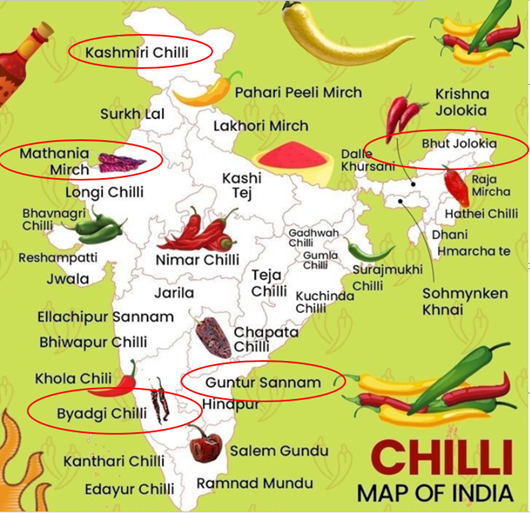
India, long a hub of the global spice trade, became the point where the chili peppers from the Americas fused with Asian culinary traditions. The result was nothing short of revolutionary. From the fiery Chettinaad curry or Tomato chilly chutney of the south to the Rogan Josh or mirchi pakoda of the north, laal maas or Vindaloo of the west and Delle or Bhot Jolakia pickle in the east, chili peppers became an integral part of Indian cuisine, forever altering the flavor profile of the subcontinent’s dishes.
The World on Fire: Chili’s Lasting Legacy
Today, it’s impossible to imagine global cuisine without the chili pepper. From the tangy heat of a Thai green curry to the smoky bite of a Mexican mole, chilis have become a universal ingredient, adding spice and excitement to dishes across the world. From its origins in the Americas to its adoption by kitchens worldwide, this little fruit has truly set the world on fire—one delicious bite at a time.
 Poyekhali !
Leave a comment